

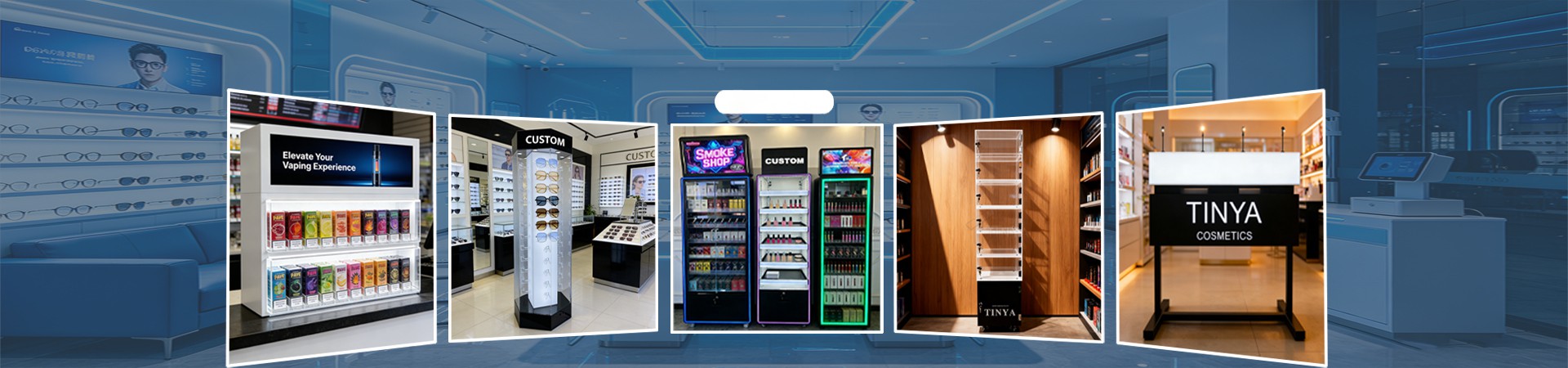

A cosmetic display can look attractive in a rendering and still fail on a real retail counter.
The lipstick slots may be too tight. A skincare bottle may block the product behind it. A perfume tester may be difficult to remove. The base may feel unstable when customers touch the products. Or the display may simply take up too much valuable counter space.
These are the problems buyers usually discover after they have already spent time and money on a sample.
A good countertop cosmetic display rack should prevent those problems before production begins.
For beauty brands, distributors, retailers and visual merchandising teams, the display is not simply a container. It needs to present the products clearly, support the brand image, survive repeated customer handling and fit the available retail space.
At TINYA, when buyers contact us about a custom cosmetic display stand, they usually ask questions about dimensions, product capacity, acrylic thickness, logo printing, lighting, MOQ, samples, lead time and packaging.
Those questions make sense because the real goal is not to buy a rack.
The real goal is to create a display that works in the store.
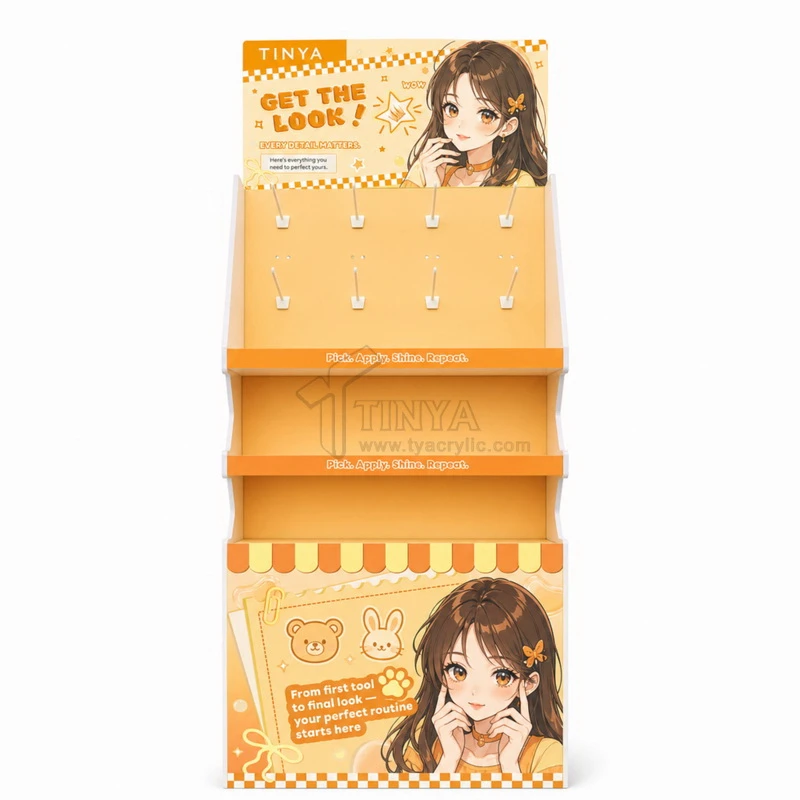
1. Why a Countertop Cosmetic Display Rack Matters
Product visibility affects the buying experience
Cosmetics are highly visual products.
Before shoppers pick up a lipstick, test a perfume or read a skincare label, they usually notice the presentation first.
A crowded counter can make premium products look ordinary. A badly planned rack can hide colors, block labels and make testers difficult to reach.
A well-designed countertop cosmetic display rack does the opposite.
It gives each item a clear position and creates a visual order that helps customers understand the product range quickly.
For example, lipstick usually benefits from a compact multi-slot structure because shoppers want to compare colors.
Perfume often needs more spacing because bottle design is part of the product appeal.
Skincare may require several platform heights because bottles, jars and boxes can vary significantly in size.
That is why the same structure should not be used for every beauty category.
The display should support the brand, not just hold products
A generic transparent rack can hold cosmetics.
A customized display should communicate the brand.
Color, material, logo position, lighting and product layout all influence how shoppers perceive the products.
A luxury perfume brand may prefer black acrylic, gold details and subtle LED lighting.
A natural skincare brand may prefer clear or frosted acrylic with softer graphics.
A colorful makeup brand may want printed panels, brighter colors and denser product arrangements.
The best display is therefore not necessarily the most complicated one.
It is the one that makes the products easier to understand while keeping the visual style consistent with the brand.

2. What Cosmetic Buyers Usually Ask Before Ordering
Size, capacity, MOQ and product fit
One of the first questions buyers ask is:
"Can this display fit our products?"
That sounds simple, but it is one of the most important questions in the entire project.
A display should be designed around the products rather than forcing the products into a standard structure.
Before starting the design, buyers should ideally provide:
product width, depth and height;
number of SKUs;
quantity displayed per SKU;
tester requirements;
counter space;
preferred display size.
The more accurate this information is, the easier it becomes to determine slot width, tier height, base size and overall capacity.
Buyers also frequently ask about MOQ.
For many customized display projects, MOQ depends on the structure, printing, materials and production process. TINYA can also support sample development before mass production, which helps buyers verify the design before committing to a larger quantity.
Samples, branding, packaging and production concerns
Once the basic structure is confirmed, buyers usually start asking more detailed questions.
| Buyer Concern | What the Buyer Really Wants to Know | TINYA Approach |
|---|---|---|
| Will my products fit? | Accurate slot and platform dimensions | Design around actual product sizes |
| Can I add my logo? | Whether branding will look professional | UV printing, silk-screen and other logo options |
| Can you match our colors? | Brand consistency | Custom acrylic colors and printed graphics |
| Can I test a sample first? | Reduce production risk | Prototype before mass production |
| Is the rack stable? | Avoid wobbling or bending | Select suitable material thickness and base structure |
| Can LED lighting be added? | Improve premium presentation | Integrate lighting where the structure allows |
| How is it packaged? | Avoid scratches and damage | Protective film, cushioning and export packaging |
| What is the MOQ? | Budget and launch flexibility | Confirm according to design and production method |
These questions matter more than simply comparing unit prices.
A low-priced display that needs to be redesigned after sampling can cost more in the long run.
3. How to Choose the Right Material and Structure
Acrylic, metal and mixed-material structures
Acrylic is one of the most common materials for a cosmetic countertop display because it is clean, customizable and suitable for many beauty categories.
Clear acrylic creates a light and modern appearance.
Colored acrylic can strengthen the brand identity.
Black or white acrylic is commonly used for premium beauty products.
However, not every display needs to be made entirely from acrylic.
Some designs work better with mixed materials.
| Material / Combination | Main Advantage | Suitable Applications |
|---|---|---|
| Clear acrylic | Clean, transparent appearance | Skincare, makeup, perfume |
| Colored acrylic | Strong brand consistency | Promotional cosmetics |
| Acrylic + metal | Better structural support | Heavier products |
| Acrylic + LED | Stronger visual impact | Perfume and premium skincare |
| Acrylic + MDF | More decorative possibilities | Branded counters and shop fixtures |
TINYA can combine acrylic with materials such as metal, MDF and ABS when the project requires additional strength, lighting or decorative elements.
Thickness, stability and long-term retail use
Material thickness is another question buyers frequently ask.
There is no single thickness that works for every acrylic cosmetic display rack.
A compact lipstick display may use thinner panels than a larger skincare display carrying multiple bottles.
The base may also need to be thicker than the upper shelves.
The correct thickness depends on:
overall size;
product weight;
number of products;
shelf span;
display structure;
expected customer handling.
A display that looks perfect in a 3D rendering can still flex or wobble if the structure is not properly engineered.
That is why material selection should happen after product dimensions and display capacity are confirmed.
4. How to Plan Size, Capacity and Product Layout
Designing around actual cosmetic products
One of the most common sourcing mistakes is deciding the display dimensions before deciding exactly what needs to be displayed.
A better approach starts with the products.
For example, imagine two buyers both want a countertop makeup display stand measuring approximately the same size.
Buyer A needs to display 24 lipsticks.
Buyer B needs to display six perfume bottles.
The external dimensions may be similar, but the internal design should be completely different.
The lipstick display needs compact slots, easy color comparison and efficient use of space.
The perfume display needs stronger platforms, more spacing and greater emphasis on bottle presentation.
That is why photos and packaging dimensions are extremely useful at the beginning of a project.
Even if you do not have technical drawings, a supplier should be able to understand the product requirements from dimensions, reference images and layout ideas.
Avoiding overcrowding and wasted counter space
Buyers often ask us to fit as many products as possible into a small area.
Capacity matters, but maximum capacity is not always the best target.
If products are packed too closely:
labels become difficult to see;
testers become difficult to remove;
different SKUs become confusing;
premium cosmetics may look less valuable;
customers may accidentally knock over nearby products.
The opposite problem is also common.
If a display is too large for the number of products, the empty space can make the presentation feel unfinished.
The goal should be to balance capacity, visibility and accessibility.
A good retail cosmetic display stand uses enough space to separate products clearly without wasting valuable counter area.

5. Branding and Customization Options Buyers Care About
Logo, colors, printing and LED lighting
For customized beauty displays, buyers rarely want only a transparent acrylic structure.
They usually want the display to match their packaging or campaign.
Typical customization requests include:
logo printing, brand colors, acrylic colors, UV graphics, silk-screen printing, LED lighting, removable graphics, drawers, locking elements and mixed-material designs.
Logo placement matters especially on small countertop displays.
If the logo is too low, products may cover it.
If it is too high, it may compete with the product packaging.
The best position depends on how shoppers see the display from the front and side.
Lighting is another common request.
LED lighting can work particularly well for perfume, skincare and luxury cosmetic displays, but it should support the product rather than overpower it.
Turning a reference image into a production-ready design
Many buyers do not have CAD drawings.
They may only have:
a competitor display photo;
a rough sketch;
a product rendering;
a store photo;
or packaging dimensions.
That is enough to start a discussion.
TINYA provides design support including 2D and 3D development, allowing buyers to review the structure before moving to sampling.
This is especially useful when the buyer knows what they want visually but is unsure how the product should be manufactured.
Instead of asking the buyer to solve the engineering problem, the supplier should help turn the visual idea into a practical structure.
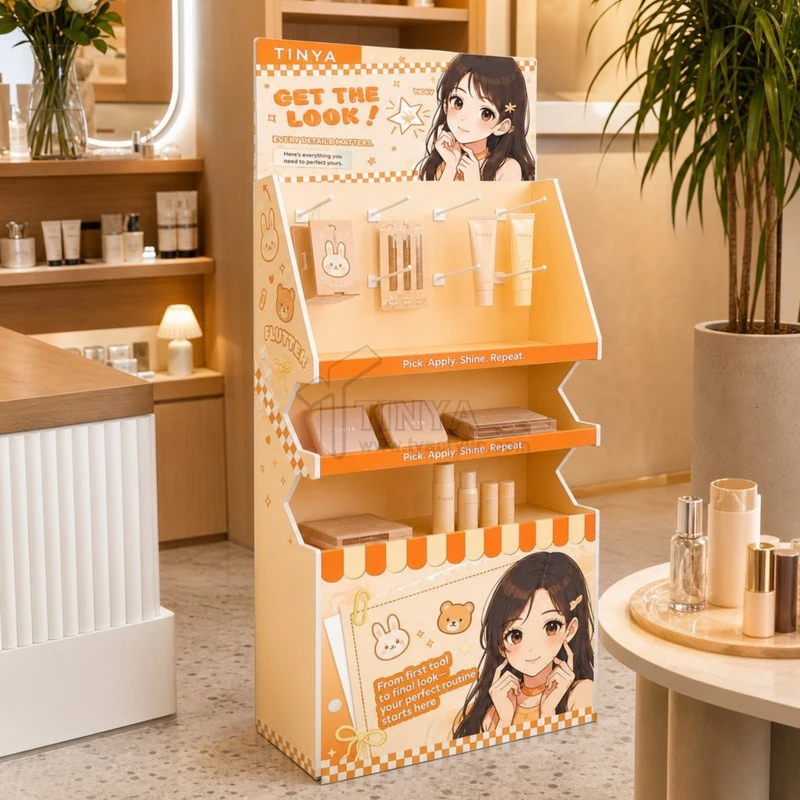
6. Sampling, Packaging and Quality Control
What should be checked during sampling
Sampling is not only about checking whether the finished rack looks attractive.
A sample should answer practical questions.
Do the products fit correctly?
Are the slots too tight?
Can customers remove the testers easily?
Is the rack stable?
Does the logo sit in the right position?
Are the colors correct?
Does the lighting create the expected effect?
Is assembly simple?
TINYA supports customized samples, with typical sample development taking around 3–7 working days depending on the structure and customization requirements.
If the sample reveals a problem, it is much easier to adjust one prototype than hundreds of finished units.
This is why experienced buyers usually view sampling as part of quality control rather than an unnecessary cost.
Packaging and shipment protection
Packaging is particularly important for acrylic displays.
Even when the structure is strong, polished acrylic surfaces can be scratched during transportation if they are not protected correctly.
Depending on the design, packaging may include:
protective film;
foam;
corner protection;
individual cartons;
outer cartons;
knock-down packaging.
Larger displays may be designed as KD structures to reduce carton volume and shipping costs.
Before ordering, buyers should ask whether the quotation is based on assembled or flat-packed packaging because the difference can affect freight significantly.
7. How to Choose a Reliable Cosmetic Display Manufacturer
What buyers should check before placing a bulk order
A good-looking product photo does not tell you whether a supplier can consistently produce customized retail displays.
Before selecting a cosmetic display manufacturer, buyers should evaluate the supplier's complete process.
Can they understand product dimensions?
Can they create or revise drawings?
Can they produce samples?
Can they combine acrylic with metal or other materials?
Can they control printing quality?
Can they package the display correctly?
Can they support repeat orders?
Can they communicate clearly when the design needs adjustment?
For international buyers, the quality of communication is often just as important as production capability.
When the supplier asks the right questions at the beginning, many problems can be prevented before production starts.
How TINYA helps reduce customization risk
TINYA has been working with customized acrylic and retail display products since 2005, supporting OEM and ODM projects across different retail categories.
For a countertop cosmetic display rack, our goal is not simply to reproduce a reference photo.
We look at the actual cosmetics, available counter space, product weight, branding requirements and order quantity before recommending the structure.
If you have a reference image but no drawing, we can help develop the design.
If you are unsure about material thickness, we can recommend a suitable structure based on the product load.
If you want to test the display before mass production, a sample can be produced first.
This approach helps reduce one of the biggest risks in customized display sourcing: discovering design problems too late.

Frequently Asked Questions
What information do I need to send for a quotation?
Send the cosmetic product dimensions, expected display quantity, number of SKUs, available counter size, logo requirements and any reference photos you have.
The more information you provide at the beginning, the more accurate the quotation and structure recommendation can be.
What is the MOQ for a custom countertop cosmetic display rack?
MOQ depends on the design, materials, printing and manufacturing process. For many customized display projects, quantities around 50 pieces may be possible, but the final MOQ should be confirmed after reviewing the design.
Can I order a sample first?
Yes.
For customized displays, producing a sample before bulk production is recommended because it allows you to test size, structure, color, logo position and product fit.
Can you customize the size and product capacity?
Yes.
The display can be designed around your actual cosmetics and available counter space.
Can TINYA add our brand logo?
Yes.
Available branding processes can include UV printing, silk-screen printing and other methods depending on the design and material.
Can you add LED lighting?
Yes.
LED lighting can be incorporated into suitable designs, especially perfume, skincare and premium cosmetic displays.
Can the display be shipped flat-packed?
Yes, depending on the structure.
For larger displays, KD design can help reduce packaging volume and freight cost.
What cosmetic products can these racks display?
They can be customized for lipstick, skincare, perfume, foundation, palettes, beauty tools, testers and many other cosmetic products.
Start Your Countertop Cosmetic Display Project
A successful countertop cosmetic display rack starts with understanding the products, not choosing a rack from a catalog.
The most useful information you can send is simple:
your product dimensions, quantity, available counter space and reference images.
From there, TINYA can help you evaluate the layout, material, structure, branding and sampling requirements before mass production.
If you are developing a new cosmetic display project, send us your product information and reference photos.
Email: seo@tinya168.com
WhatsApp: +86 199 2655 8676
We can help you turn your cosmetic packaging and retail requirements into a practical custom display solution.