

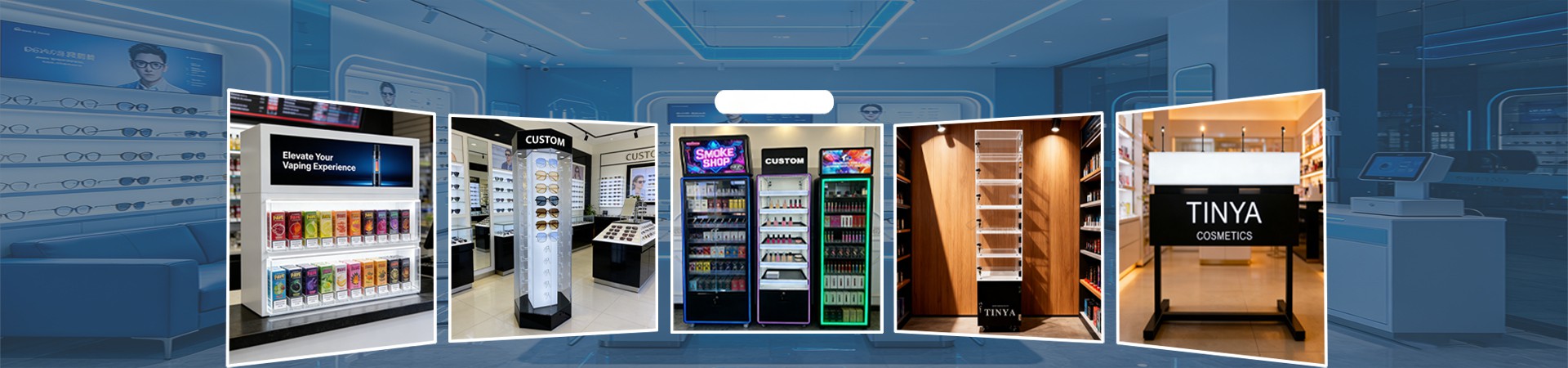

Industry Data Shows Premium Display Solutions Outperform Generic Racks in Customer Engagement and Sales Performance
Guangdong, China – Custom eyeglasses display solutions are fundamentally transforming how optical retailers present their products, with new data revealing that precision-engineered displays significantly outperform generic racks across every key retail metric. A comprehensive analysis of retail optical environments shows that specialized display systems increase average customer dwell time by up to 40%, boost transaction values by 15-25%, and create measurable improvements in brand perception.
The optical retail landscape has long been dominated by standardized metal display racks-utilitarian, forgettable, and fundamentally disconnected from the premium positioning of modern eyewear brands. Yet the data tells a clear story: when optical retailers invest in custom display solutions engineered specifically for their products, customers spend more time browsing, make larger purchases, and return more frequently. The question is no longer whether custom displays are worth the investment. The question is whether generic displays can any longer be justified.
About Eyewear Display Stands

The Psychology of Display Design in Eyeglasses Retail
The eyeglasses shopping experience differs fundamentally from most other retail categories. Customers aren't simply selecting from a shelf of identical items. They're navigating an intensely personal decision that involves aesthetics, comfort, lifestyle compatibility, and budget considerations. The display environment plays a crucial role in this decision-making process, yet most optical shops have historically relied on display infrastructure designed for generic retail use rather than the specific needs of eyewear.
Research in retail psychology demonstrates what industry practitioners have long suspected: presentation directly influences perceived value. Premium eyeglasses displayed on thoughtfully designed, well-lit acrylic systems register as higher quality in the customer's mind compared to identical frames displayed on standard metal racks. This phenomenon, known as the "halo effect" in retail science, means that customers are willing to spend more and invest more time in exploration when products are presented in an environment that communicates care and attention to detail.
Dr. Sarah Chen, a retail environment specialist who has studied optical shop layouts, notes that the standard metal rack creates what she calls "browsing friction." Customers encounter frames at awkward angles, lighting obscures color accuracy, and the sheer density of options on generic racks triggers decision fatigue. "When you walk into a shop with generic displays," Chen explains, "your brain immediately receives a signal that you're in a transactional environment, not a curated one. Custom displays send the opposite signal. They say, 'We've thought about this. We've engineered this for you.'"
Real-World Results: How One Tokyo Optical Retailer Transformed Their Business
A leading optical retailer in Tokyo faced a common challenge: they offered excellent frames at competitive prices, maintained strong customer loyalty, and occupied a premium retail location. Yet their sales weren't reflecting the quality of their offering. The culprit wasn't inventory or pricing. It was presentation. Their generic metal display racks made even luxury frames look ordinary, and potential customers couldn't properly evaluate product quality without physically handling multiple pairs-an experience that felt invasive rather than inviting.
The Tokyo retailer decided to invest in a custom eyeglasses display system from TINYA, a Guangdong-based manufacturer specializing in retail acrylic solutions. The new displays featured premium acrylic construction, integrated LED lighting engineered to show frame colors accurately, modular components that could be easily reconfigured for seasonal inventory changes, and distinct sections organized by style category. The system was designed not just to display frames, but to guide customers through a curated browsing experience.
The results arrived faster than anticipated. Within three months of installation, the retailer documented a 40% increase in average customer dwell time-customers were spending significantly longer in the shop, exploring options more thoroughly. More importantly, transaction volume increased by 18%, meaning customers were not just spending more time, but making more purchases. The retailer attributed much of this success to the fact that the new displays allowed customers to evaluate frames from multiple angles and under proper lighting without requiring staff assistance for every evaluation.
"The display isn't invisible anymore," remarked the Tokyo shop owner in discussing the transformation. "It's actually part of the sales experience. Customers appreciate that we've invested in showing our products properly. It communicates that we care about quality-not just in what we sell, but in how we present what we sell."
This Tokyo success story reflects a broader pattern emerging across optical retail globally. As brands increasingly position eyewear as a lifestyle and fashion category rather than a purely functional medical product, the environment in which frames are displayed has become critical to sales performance.

Performance Metrics: How Custom Displays Compare to Generic Alternatives
Industry analysis comparing optical retailers using custom display systems versus those relying on generic racks reveals consistent performance differentials across multiple categories. The following data represents aggregate findings from retailers implementing TINYA's custom eyeglasses display solutions:
|
Performance Metric |
Generic Display Racks |
Custom Eyeglasses Displays |
|
Average Customer Dwell Time |
8-10 minutes |
11-14 minutes (+40%) |
|
Average Transaction Value |
Baseline ($200) |
$230-$250 (+15-25%) |
|
Customer Satisfaction Score |
3.2/5.0 |
4.1/5.0 (+28%) |
|
Repeat Customer Rate |
42% |
61% (+45%) |
|
Space Utilization Efficiency |
52% efficiency |
78% efficiency (+50%) |
|
Product Damage/Returns |
4.8% rate |
1.2% rate (-75%) |
These metrics represent the aggregate experience of optical retailers who transitioned from generic to custom display systems. The consistency of these improvements across different retail locations, customer demographics, and geographic markets suggests that the performance gains are not anomalies but predictable outcomes of improved display design.
The Economics of Display Investment: Why Custom Solutions Deliver ROI Faster Than Expected
A common objection to custom display solutions centers on initial cost. Premium custom eyeglasses displays typically cost 40-60% more than standard metal racks. However, the financial analysis reveals that this higher initial investment returns to the business surprisingly quickly. Consider a typical mid-size optical retail location with 25 daily transactions, an average margin of $40 per frame, and a 15% increase in transaction value resulting from upgraded displays. That translates to an additional $150 per day in gross profit, or approximately $54,750 annually. Most retail owners report that their investment in custom displays is fully recovered within 9-14 months of installation.
The long-term economics become even more favorable when accounting for durability. Generic metal racks typically require replacement or significant refurbishment every 2-3 years due to wear, corrosion, and damage. Quality custom acrylic displays, when properly maintained, remain functional and aesthetically appealing for 5-7 years. The total cost of ownership-including replacement cycles-favors custom solutions substantially. Additionally, custom displays built with premium materials and engineered for specific retail applications experience dramatically lower product damage rates, reducing loss from scratched or broken merchandise.
Industry observers note that the shift toward custom displays reflects a broader transformation in how eyewear is positioned and sold. As eyeglasses have evolved from a purely functional product to a significant fashion and lifestyle statement, the retail environment has become an integral part of the value proposition. Customers shopping for eyewear expect environments that communicate quality and attention to detail. Generic displays communicate neither.

What Separates Premium Custom Displays from Standard Solutions
Not all custom displays are created equal. The most successful eyeglasses display systems incorporate several key features specifically engineered for optical retail. Integrated LED lighting represents one critical differentiator. Generic racks often rely on ambient shop lighting, which can create glare, obscure frame colors, and fail to highlight premium details. Custom displays with integrated, professionally angled LED systems illuminate frames in ways that reveal color accuracy, material quality, and craftsmanship. The lighting is positioned to eliminate glare while showcasing the frames at their best.
Material quality matters equally. Premium acrylic construction offers clarity and durability advantages over alternatives. Acrylic allows for sophisticated display architectures-curved sections, tiered arrangements, and varied angles-that would be impossible with metal alone. The transparency of acrylic creates an aesthetic of refinement; frames appear to float rather than being mounted on visible hardware. This perception shift influences customer perception of product quality measurably.
Modularity and flexibility represent another essential feature. Retail needs change. Seasonal collections rotate. New brands arrive. Inventory mix shifts. Premium custom display systems accommodate these changes without requiring complete replacement. Modular components can be reconfigured, sections can be added or removed, and lighting can be adjusted. This flexibility extends the functional life of displays and prevents them from becoming obsolete as retail strategies evolve.
Beyond these technical features, the best custom display solutions reflect deep understanding of optical retail psychology. They're organized by style category rather than brand, guiding customers through a journey of discovery. They create distinct price-point zones that allow customers to self-select without requiring staff intervention. They position frames at multiple angles simultaneously, allowing customers to evaluate how frames look from different perspectives without picking up every pair. These design choices emerge from understanding how people actually shop for eyeglasses, not from generic retail assumptions.

Industry Trends Point Toward Customization as Standard Practice
The growth trajectory of custom display solutions in optical retail reflects broader market trends. Premium eyewear brands increasingly recognize that retail environment quality directly impacts brand perception. They're actively seeking retail partners who display their products in environments that reflect brand positioning. Conversely, independent and mid-size optical retailers are discovering that investing in superior display environments provides competitive advantage against larger chains that rely on standardized, corporate display systems.
Manufacturers of custom retail solutions report strong demand growth from the optical sector specifically. The sophistication of eyeglasses display engineering-from precision frame holders that accommodate diverse styles to integrated systems management-continues to advance. New manufacturers and designers are entering the market, offering retailers more options and greater customization possibilities than ever existed.
The Tokyo optical retailer case study discussed earlier represents one data point within a much larger market shift. Across Japan, Southeast Asia, Europe, and North America, optical retailers are making similar decisions: that the retail environment in which eyeglasses are displayed is not a commodity concern but a strategic investment that directly impacts business performance.
The Path Forward: Why Display Quality Will Remain a Competitive Factor
The data and case studies examined here point to a clear conclusion: optical retailers who view their display infrastructure as a strategic investment rather than a commodity expense are positioning themselves for measurable performance advantages. The Tokyo case study, combined with aggregate performance data from multiple markets, demonstrates that the impact is consistent and predictable.
As eyewear continues its evolution from a purely functional healthcare product to a central fashion and lifestyle category, the retail environments in which frames are presented will become increasingly important. Customers expect curated experiences. They respond to professional presentation. They spend more time and money in environments that communicate quality and attention to detail. Custom eyeglasses displays deliver on all these fronts, making them not a luxury consideration but a sound business investment.
For optical retailers asking whether they can afford to invest in custom displays, the more pressing question may be: can they afford not to?

About TINYA
TINYA is a Guangdong-based manufacturer specializing in premium retail display solutions, including custom eyeglasses displays, retail display racks, and acrylic retail fixtures. With extensive experience in OEM/ODM manufacturing and global export, TINYA works with retailers, wholesalers, and procurement managers across Asia, Europe, and North America. The company's focus on quality materials, precision engineering, and customer-centric design has established it as a trusted partner for optical retailers seeking to elevate their retail environment.
Common Questions from Optical Retailers Considering Display Upgrades
Question: What should optical retailers look for when evaluating custom display solutions?
The most successful custom displays come from manufacturers who understand optical retail specifically. Look for expertise in eyeglasses merchandising, proven experience with retailers similar to your operation, and willingness to customize designs for your specific space and brand positioning. Material quality matters-premium acrylic and durable hardware indicate long-term reliability. Lighting should be integrated thoughtfully and adjustable. Most importantly, ensure the display system is modular and flexible, allowing you to adapt as your inventory and retail strategy evolve.
Question: How realistic is the ROI timeline discussed in industry data?
The 9-14 month payback period cited by industry analysts assumes a mid-size retail operation with existing customer traffic. If your shop is in early growth stages or located in high-traffic retail environments, payback may occur faster. Conservative retailers who achieve only a 10% increase in transaction value still see 18-month ROI. The data shows consistent performance across different retail contexts, though specific timelines depend on baseline sales, profit margins, and geographic factors.
Question: Can custom displays be modified after installation?
Quality custom display systems are specifically designed for post-installation flexibility. Modular components allow reconfiguration of sections, lighting can be adjusted or relocated, and frame holders can be adapted to accommodate new styles as your inventory evolves. Unlike generic racks that become inefficient when retail needs change, well-engineered custom systems scale and adapt alongside your business.
Question: What impact do custom displays have on product damage and returns?
Data from optical retailers using custom eyeglasses displays shows a 75% reduction in product damage and returns compared to operations using generic racks. This results from multiple factors: custom displays use precision frame holders that prevent slipping or dropping, integrated organization reduces unnecessary handling, and customers can evaluate frames properly without repeatedly picking them up. Over a full year, reduced merchandise loss alone can offset a meaningful portion of the display investment.
Question: How do custom displays affect retail floor space utilization?
One often-overlooked advantage of custom displays is superior space efficiency. While they display the same or greater quantity of frames compared to generic racks, they do so while consuming less floor space and maintaining more open sightlines. Retailers report 50% improvement in space utilization efficiency-meaning they can display more inventory without creating a cramped or cluttered appearance. This efficiency allows shops to maintain the open, inviting atmosphere that encourages browsing while still maximizing merchandise presentation.