

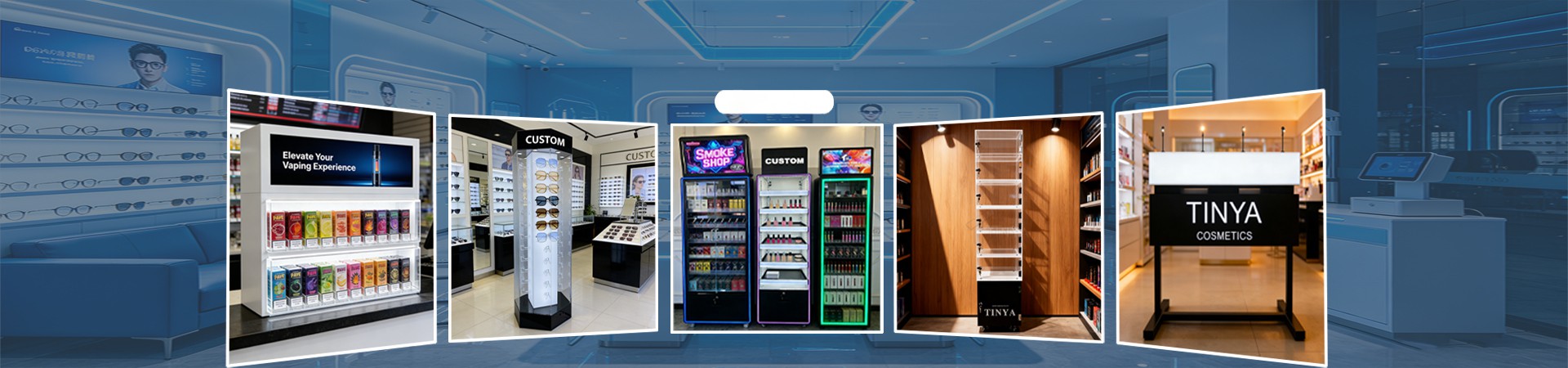

For a purchasing manager, ordering one beautiful acrylic display stand is relatively easy.
Ordering 500, 1,000 or several thousand custom acrylic display stands for a retail rollout is something completely different.
The real question is rarely:
"Can you make this acrylic display?"
The real question is:
"Can you make hundreds of them consistently, deliver them on time, protect them during international shipping, and reproduce the same quality when we reorder six months later?"
That is the difference between buying a display product and managing a retail display project.
For brands, distributors, visual merchandising companies and retail chains, a custom acrylic display stand is not simply a piece of transparent plastic used to hold products. It becomes part of the customer experience, brand identity and physical retail environment.
When hundreds of displays are installed across multiple stores, even a small manufacturing problem can become a large operational problem.
This is why experienced buyers increasingly evaluate an acrylic display stand manufacturer based on engineering capability, sampling control, production consistency, packaging and repeat-order reliability rather than unit price alone.

What Is a Custom Acrylic Display Stand?
A custom acrylic display stand is a retail merchandising fixture manufactured from PMMA acrylic and designed around a specific product, brand, store environment and display requirement.
Unlike standard acrylic risers or stock display holders, a custom display may include specific dimensions, product slots, shelves, printed graphics, logos, LED lighting, locks, drawers, metal components or removable structures.
They are commonly used for cosmetics, skincare products, perfumes, jewelry, watches, electronics, mobile phone accessories, collectibles, food products and other retail merchandise.
For large commercial projects, however, the design of the display must consider much more than appearance.
It must also consider product weight, acrylic thickness, unsupported shelf span, customer access, replenishment, assembly, transportation and repeat production.
That is where manufacturing experience starts to matter.
A Good Sample Does Not Automatically Mean Good Mass Production
Imagine a cosmetics brand preparing to launch a new skincare collection across 300 stores.
The marketing team has already approved the retail campaign.
Packaging is finished.
Store launch dates have been scheduled.
The purchasing department receives a beautiful acrylic display sample.
The acrylic is clear.
The logo position looks correct.
The shelves hold the products perfectly.
Everyone approves the prototype.
The natural assumption is that the difficult part is finished.
In reality, the difficult part may only be beginning.
Moving from one carefully manufactured prototype to hundreds or thousands of identical units requires a completely different level of process control.
Commercial sourcing guidance for custom display projects commonly emphasizes drawing approval, physical sample confirmation, production specifications and packaging controls before mass production begins because errors discovered after production starts become dramatically more expensive to correct.
A drawing mistake corrected before cutting may cost almost nothing.
The same mistake repeated across 500 displays can require reworking or replacing hundreds of components.
That is why the approved sample should not simply be treated as a visual reference.
It should become part of a repeatable manufacturing standard.

Why Large Buyers Should Compare More Than Unit Price
The lowest quotation can sometimes become the most expensive purchasing decision.
Consider two suppliers quoting the same custom acrylic cosmetic display.
Supplier A offers a lower unit price.
Supplier B costs slightly more but confirms the product dimensions, load requirements, artwork, acrylic thickness, packing structure and production tolerances before manufacturing.
Initially, Supplier A may appear more competitive.
However, after the displays arrive, several problems could change the calculation completely.
The shelves may bend slightly after products are loaded.
The logo color may differ from the approved artwork.
Some displays may arrive scratched.
Certain product compartments may be too tight.
Several cartons may become damaged during transportation.
The purchasing department is no longer comparing a difference of a few dollars per display.
It is now managing replacements, delays, freight costs and complaints from the retail team.
For large projects, therefore, the true cost of an acrylic display is better understood as:
Display Cost + Quality Risk + Packaging Risk + Rework Risk + Delay Risk + Replacement Cost
The best supplier is not necessarily the factory with the lowest quotation.
It is the factory that can make the final landed project more predictable.
What Should a Buyer Compare Before Ordering Custom Acrylic Display Stands?
| Procurement Factor | What the Buyer Should Confirm | Why It Matters for Large Orders |
|---|---|---|
| Product dimensions | Actual product size, weight and required clearance | Prevents products from fitting too tightly or moving excessively |
| Acrylic thickness | Thickness matched to span, load and structure | Helps reduce bending, cracking and unnecessary material cost |
| Structural design | Joints, supports, shelves, screws, magnets and reinforcement | Determines long-term stability |
| Branding | Logo size, Pantone color, printing location and printing process | Protects brand consistency across stores |
| Sample approval | Dimensions, appearance, loading and functional testing | Creates a reference before mass production |
| Production consistency | Approved drawings, cutting files and manufacturing controls | Helps maintain consistency across hundreds of units |
| Packaging | Protective film, separators, foam, carton structure and drop protection | Reduces scratches and transportation damage |
| Assembly | Fully assembled, semi-assembled or knock-down design | Influences freight cost and store installation |
| Quality inspection | Dimensions, appearance, printing, assembly and packing | Finds problems before shipment |
| Repeat orders | Retention of drawings, specifications and production files | Makes future replenishment faster and more consistent |
For a purchasing manager, this table often reveals more about a supplier than a product catalog.
A supplier who immediately provides a price without asking about these factors may not yet understand the actual risk of the project.
Why Product Weight Changes Acrylic Display Design
One of the most common mistakes in custom retail displays is designing only according to appearance.
A rendering may look perfect.
Transparent shelves appear elegant.
LED lighting creates a premium atmosphere.
The logo appears perfectly positioned.
But a rendering does not carry weight.
It does not experience months of customer interaction.
It does not travel inside an export carton.
If a shelf is too thin or has too much unsupported span, it may gradually bow after products are placed on it.
A stand designed for lightweight lipstick is very different from one holding perfume bottles, electronics or multiple packaged products.
A professional acrylic display manufacturer should therefore consider what the display will actually hold before determining the final construction.
For some projects, increasing acrylic thickness makes sense.
For others, changing the shelf structure or adding discreet reinforcement may achieve better stability without unnecessarily increasing material cost.
Good engineering is often invisible.
The shopper only sees a clean retail display.
The purchasing manager benefits from everything hidden behind it.
Why Actual Product Samples Can Be More Valuable Than Drawings
Packaging drawings are helpful, but the physical product can reveal information that drawings do not always show.
Rounded corners, flexible packaging, caps, protruding components and manufacturing tolerances can influence how the product fits inside the display.
For this reason, when possible, actual product samples can be used during the development of a custom acrylic display.
For cosmetic bottles, for example, a few millimeters of additional clearance may make restocking easier.
For electronics, cable routing may influence the structure.
For watches or jewelry, the viewing angle may matter more than the overall dimensions.
For retail merchandising, the question is therefore not simply:
"Does the product fit?"
A better question is:
"Can the shopper see it clearly, remove it naturally and can store employees refill the display easily?"
That is the difference between manufacturing an acrylic holder and designing a retail display.

Why Sample Approval Should Become a Production Standard
A successful sample should create measurable standards for mass production.
The buyer and manufacturer should be able to identify the approved dimensions, acrylic thickness, material, color, printing, hardware, assembly method and packaging configuration.
When these specifications are controlled, the factory has something objective to reproduce.
When they are not controlled, production becomes dependent on interpretation.
This becomes especially important for repeat orders.
Imagine a customer returning eight months later and requesting another 800 units for a new store rollout.
Ideally, the manufacturer should not need to reverse-engineer the previous product from photographs.
The original manufacturing information should already define what needs to be reproduced.
For a serious retail program, repeatability is one of the most valuable characteristics of a manufacturing partner.

Why Packaging Should Be Designed Before Production Is Finished
Many buyers spend weeks discussing acrylic thickness, printing and dimensions but only discuss packaging after the display is finished.
That can be a mistake.
Acrylic has a highly visible surface.
A small scratch that might be almost invisible on metal or painted wood can be obvious on clear PMMA.
During international shipping, displays may experience vibration, compression, loading, unloading and movement inside the carton.
Protective film helps protect acrylic surfaces, but good export packaging must also control movement.
Panels should not rub against one another.
Corners may require additional protection.
Hardware should be separated.
Empty space inside the carton should be controlled.
For certain large displays, the packaging design can even influence the product structure itself.
A fully assembled display may be convenient for stores but occupy significantly more shipping volume.
A knock-down structure may reduce freight cost but requires more precise assembly engineering.
There is no universally correct answer.
The correct packaging strategy depends on display size, quantity, destination, freight method and installation requirements.

Fully Assembled or Flat-Pack Acrylic Display?
For many purchasing projects, this decision can significantly affect total landed cost.
A fully assembled acrylic display is usually easier for the retail team because it can often be taken out of the carton and used immediately.
However, assembled structures may require larger cartons and therefore more shipping space.
Flat-pack or knock-down displays can reduce carton volume, especially for larger retail fixtures.
But reducing shipping volume should not create a difficult installation process.
Screws, metal brackets, magnets, slots or locking structures must align correctly.
Instructions need to be understandable.
Assembly needs to remain consistent from one store to another.
Therefore, the ideal design should balance manufacturing cost, freight cost, assembly difficulty and structural stability.
What Large Buyers Actually Want From an Acrylic Display Manufacturer
Large buyers rarely want to manage the factory.
They want the factory to manage manufacturing.
The purchasing manager does not want to repeatedly remind the supplier about dimensions.
The designer does not want to discover that the manufacturing process cannot reproduce the rendering.
The marketing department does not want different logo colors in different stores.
The warehouse does not want damaged cartons.
The retail team does not want complicated assembly instructions.
Management does not want a launch delayed because the displays were not ready.
What all of these departments want is predictability.
This is why the value of a manufacturer is not defined only by cutting, polishing and bonding acrylic.
The manufacturer also needs to help convert a commercial idea into something that can be manufactured consistently.
How TINYA Approaches a Custom Acrylic Display Project
At TINYA, we prefer to understand how the display will actually be used before finalizing the manufacturing solution.
A customer may provide a completed CAD drawing, a rendering, a reference photograph or only a rough idea.
All of these can be valid starting points.
Before mass production, however, the idea needs to become a manufacturing specification.
We therefore look at the dimensions of the displayed products, expected load, retail environment, acrylic thickness, structure, branding, lighting requirements, packaging and order quantity.
If the original concept creates a structural or manufacturing risk, the objective is not simply to say that it cannot be produced.
The objective is to find a practical way to preserve the design concept while improving manufacturability.
Sometimes that means changing acrylic thickness.
Sometimes it means adding reinforcement.
Sometimes a joint needs to move several millimeters.
Sometimes changing the structure makes flat packing possible and reduces shipping volume.
Sometimes the most useful thing a manufacturer can tell a buyer is:
"This part could create a problem during mass production. We recommend solving it before the sample is approved."
That conversation may make the development stage slightly longer.
But it can make mass production significantly easier.

What Information Should You Send for an Accurate Acrylic Display Stand Quote?
For an initial custom acrylic display quotation, buyers should ideally provide the product being displayed, approximate display dimensions, expected order quantity, desired material or acrylic thickness, logo requirements, structural requirements and destination country.
If a detailed CAD drawing is not available, a reference photograph or simple sketch can still be enough to begin discussing the project.
For displays designed around specific retail products, providing product dimensions or physical samples can significantly improve the development process.
The goal is not to require the buyer to complete the engineering.
The goal is to give the manufacturer enough information to engineer the display correctly.
FAQ About Custom Acrylic Display Stands
What is the best acrylic thickness for a retail display stand?
There is no single best thickness for every acrylic display stand. The appropriate thickness depends on the overall dimensions, unsupported span, product weight, structure and intended use. Lightweight countertop displays may require less material than large floor-standing displays or shelves carrying heavy perfume bottles and electronics. A manufacturer should evaluate the load and structure before recommending thickness.
Can acrylic display stands be completely customized?
Yes. Custom acrylic display stands can be manufactured according to required dimensions, colors, structures and branding. Depending on the project, customization may include shelves, product slots, printed logos, UV graphics, silk-screen printing, laser engraving, LED lighting, locks, drawers, metal components and removable structures.
What information does a manufacturer need to quote a custom acrylic display?
The most useful information includes the product being displayed, product dimensions and weight, desired display size, estimated order quantity, logo or artwork requirements, structural requirements and delivery destination. CAD drawings are useful but are not always required for an initial discussion.
Should I order a sample before mass production?
For custom commercial displays, sample approval is strongly recommended before large-scale production. A physical sample allows the buyer to check dimensions, product fit, stability, appearance, printing, assembly and packaging before the same design is repeated across hundreds or thousands of units.
How do manufacturers keep bulk acrylic displays consistent with the approved sample?
Consistency is improved by using approved drawings, fixed specifications, production files, manufacturing fixtures or jigs where appropriate, controlled artwork and quality inspection standards. The approved sample can also serve as a physical reference during production.
How can acrylic displays be protected from scratches during international shipping?
Clear acrylic normally has protective film during manufacturing and transportation. Additional packaging may include individual bags, foam, separators, reinforced cartons and corner protection depending on the display structure. The objective is to prevent acrylic surfaces from rubbing against each other and reduce movement inside the carton.
Are flat-pack acrylic display stands cheaper to ship?
They can be. For larger displays, knock-down construction may significantly reduce carton volume and freight cost. However, the structure must be engineered for accurate and simple assembly. The best option depends on display dimensions, quantity, shipping method and installation requirements.
Can an acrylic display manufacturer reproduce the same design for repeat orders?
A manufacturer that retains the approved drawings, artwork specifications, material requirements and production files should be able to reproduce the design more consistently for future orders. This is particularly important for brands that regularly replenish stores or expand into new retail locations.
Can acrylic displays include LED lighting?
Yes. LED lighting can be integrated into many acrylic retail displays, including cosmetic displays, perfume stands, electronics displays and branded countertop fixtures. The lighting position, wiring route, power supply and maintenance access should be considered during the structural design stage rather than added after the display has already been engineered.
Is acrylic better than glass for retail displays?
The better material depends on the application. Acrylic provides high optical clarity, lower weight than glass and extensive fabrication flexibility, which makes it suitable for many custom retail display applications. Glass may still be appropriate for certain architectural or highly scratch-sensitive installations. The correct material should be selected according to the retail environment and expected use.
How should I compare different acrylic display stand manufacturers?
Do not compare quotation prices alone. Compare whether each supplier is quoting the same dimensions, material, thickness, printing, packaging, sample procedure and inspection scope. Otherwise, two prices that look similar may represent significantly different products.
What products are commonly displayed on custom acrylic stands?
Custom acrylic display stands are widely used for cosmetics, skincare products, perfumes, jewelry, watches, mobile phones, phone accessories, consumer electronics, collectibles, food products and other retail merchandise. The structure should be designed around the weight, dimensions and shopper interaction requirements of the specific product.
The Real Product a Large Buyer Is Purchasing Is Predictability
An acrylic display stand does not succeed simply because it looks beautiful when photographed inside a factory.
It succeeds when 500 units arrive and still look like the approved sample.
It succeeds when products fit correctly.
When shelves stay stable after being loaded.
When brand colors remain consistent.
When store employees can install or replenish the display without difficulty.
When cartons survive international transportation.
And when the purchasing team can reorder the same display months later without starting the entire development process again.
For a large retail buyer, this is ultimately what separates a general acrylic fabricator from a reliable custom acrylic display stand manufacturer.
The factory is not simply producing transparent plastic components.
It is helping the buyer make a retail rollout predictable.
If you are developing a custom acrylic display stand for cosmetics, skincare, perfume, jewelry, electronics or another retail product, send us your product dimensions, estimated quantity, reference image or drawing.
TINYA can review the structure and help turn the concept into a production-ready acrylic display solution.