

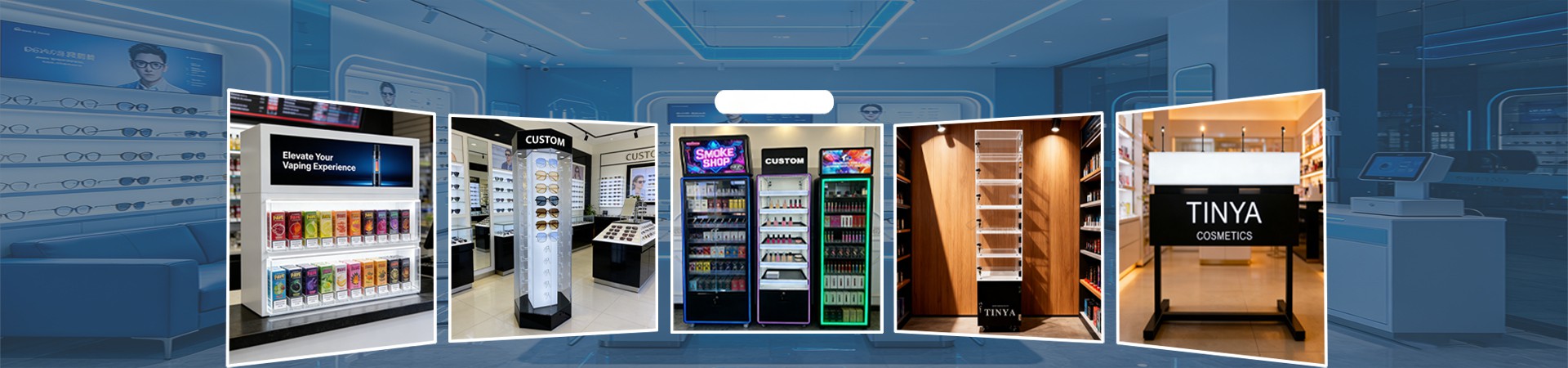

Glasses are small products, but they can be expensive. A pair of designer sunglasses may cost much more than many other items in a retail store.
This creates a challenge for eyewear shops.
Customers need to see the frames clearly, compare different styles, and sometimes try them on. At the same time, store owners need to keep their products safe.
A lockable eyewear display cabinet can help balance these needs.
It keeps eyewear organized and gives store workers more control over access to the products.
For eyewear brands, optical stores, distributors, and retail chains, choosing the right cabinet is an important part of store planning.
This guide explains the main designs, materials, safety features, and custom options available for eyewear displays.
What Is a Lockable Eyewear Display Cabinet?
A lockable eyewear display cabinet is a retail fixture used to show glasses while controlling access to them.
The cabinet usually has a transparent front or clear display area. It also has a door or another part that can be secured with a lock.
Some cabinets are small and designed for countertops.
Others are tall floor-standing units that can hold many pairs of glasses.
A lockable cabinet can be useful for premium sunglasses, designer frames, and high-value eyewear collections.
Unlike a completely open display, customers may need help from store staff before trying on a pair of glasses.
This makes the cabinet more suitable for stores where security is an important concern.
Why Do Optical Stores Use Lockable Displays?
Eyewear stores need to show different frame styles in a limited space.
A normal open display allows customers to pick up glasses easily. This can be useful for everyday shopping.
However, open displays may not be the best choice for every product.
High-value frames can be more difficult to control when customers move freely around a busy store.
A lockable cabinet offers another option.
Store workers can open the display when a customer wants to examine a frame.
When staff are busy, the products can remain behind a secured door.
This does not remove every security risk, but it can help reduce unwanted handling and casual removal.
It also creates a neat product presentation.
Which Lockable Eyewear Display Design Is Best?
Different optical stores need different types of displays.
A small boutique may only need a countertop cabinet for a few premium frames.
A large optical store may prefer a floor-standing cabinet with several shelves.
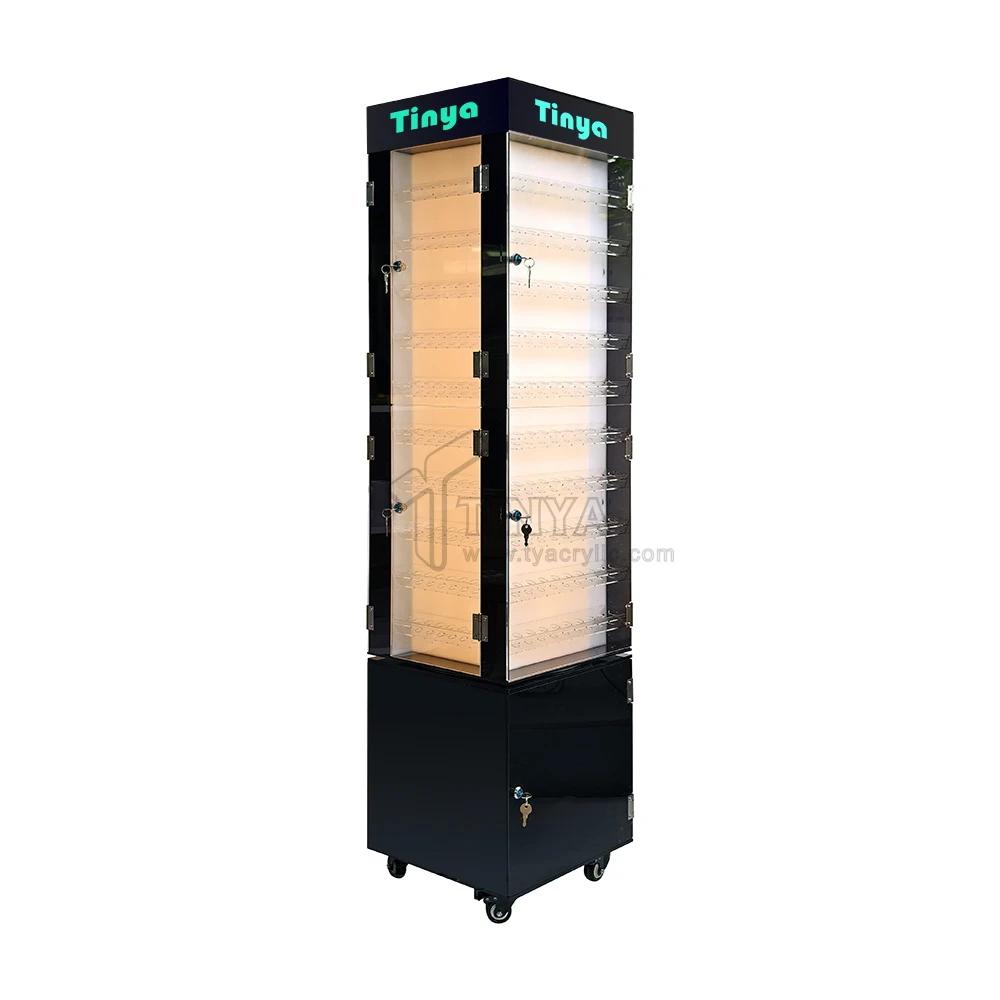
Some brands use rotating displays so customers can see products from different angles.
The table below compares common options.
| Display Type | Main Feature | Best Use |
|---|---|---|
| Countertop lockable cabinet | Compact and secure | Boutique counters |
| Floor-standing cabinet | More display capacity | Optical retail stores |
| Rotating eyewear display | Multiple viewing sides | Showrooms |
| Wall-mounted cabinet | Saves floor space | Small optical shops |
| LED eyewear cabinet | Adds product lighting | Premium sunglasses |
| Custom branded cabinet | Matching logo and colors | Eyewear brands |
The best design depends on store layout, eyewear value, and how often customers need to try on the products.
A display should look attractive, but daily use is just as important.
How Many Pairs of Glasses Can a Cabinet Hold?
The number of glasses depends on the cabinet dimensions and the spacing between frames.
Some frames are narrow, while oversized sunglasses can be much wider.
The depth and shape of the temples also affect the space needed.
Before ordering a custom cabinet, buyers should measure real frames rather than relying only on photos.
The display needs enough room between products so customers can see each design clearly.
Crowded shelves may make a cabinet look full, but they can also hide important frame details.
For premium eyewear, leaving some space around each pair can create a cleaner appearance.
If the cabinet includes special frame holders, their shape should match the glasses.
The holder should support the frame without placing too much pressure on delicate parts.
Acrylic or Glass: Which Material Should You Choose?
Acrylic and glass are both used in eyewear displays.
Clear acrylic has a modern appearance and is lighter than glass at comparable sizes.
It can also be shaped into different display structures.
Acrylic is useful for shelves, frame holders, logo panels, and transparent doors.
However, acrylic can scratch more easily than glass.
Glass can offer good clarity and scratch resistance, but it is heavier and usually needs suitable support and safe edge treatment.
Many retail cabinets combine different materials.
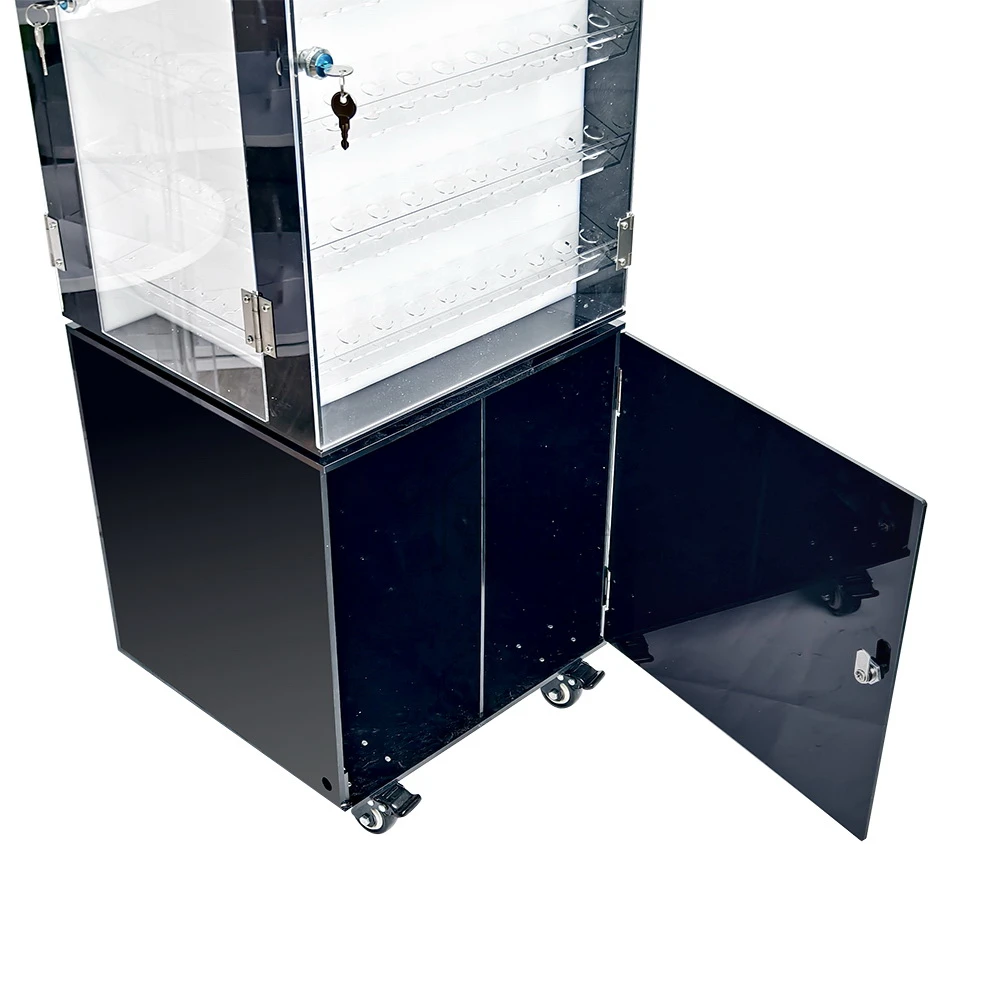
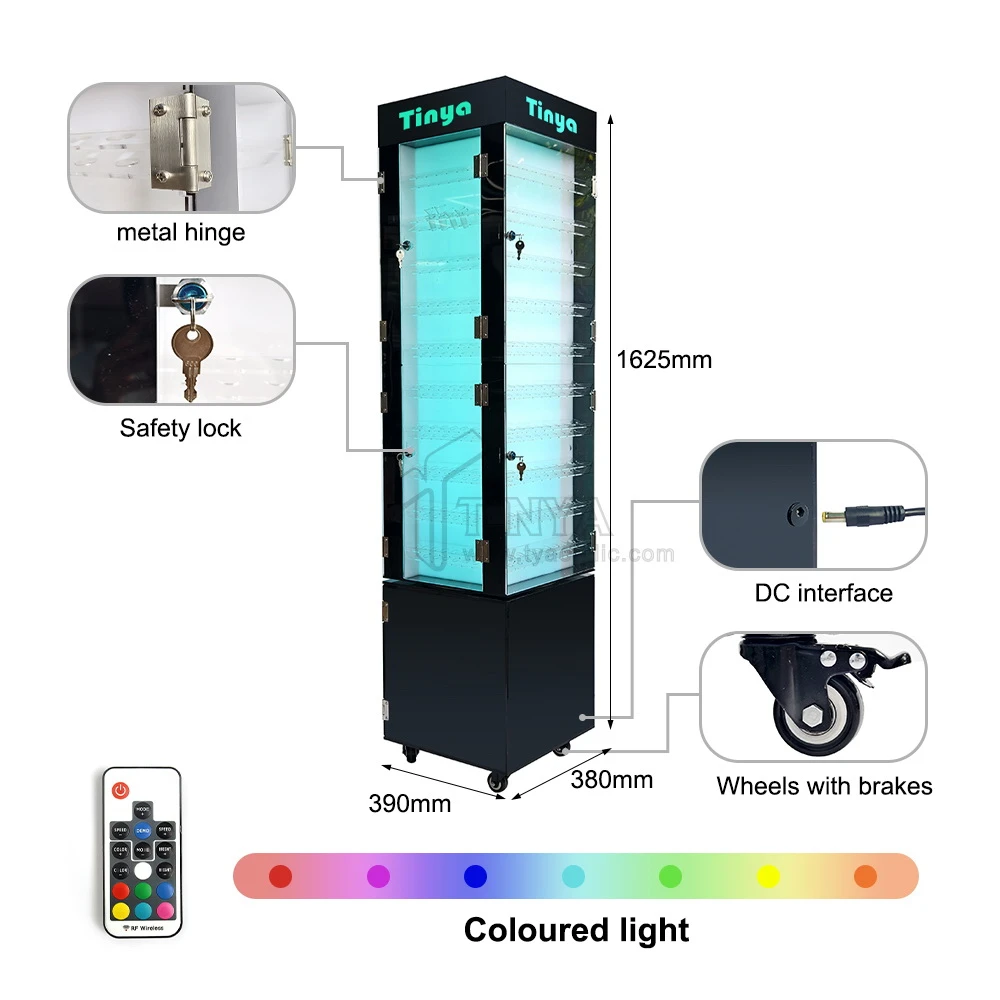
For example, a display may have a metal frame, clear acrylic shelves, and a lockable door.
A stronger base may also be needed for tall cabinets.
The final choice should depend on display size, product weight, store use, and shipping requirements.
What Security Features Should Buyers Consider?
A lock is only one part of a secure display.
The door, hinges, frame, and locking point must work together.
A weak door can make a good lock less useful.
For this reason, buyers should ask the manufacturer to test the complete opening structure.
The door should open smoothly when staff need access.
It should also close correctly without placing pressure on the displayed products.
Different stores may need different lock types.
A simple key lock may be enough for some projects.
Other stores may want a lock system that can be managed across several locations.
If a display is tall or narrow, stability is also important.
A cabinet should be tested under normal retail use, including opening the door and removing eyewear.
For higher security needs, buyers may also consider suitable store alarm systems or staff-controlled display areas.
Should an Eyewear Cabinet Have LED Lighting?
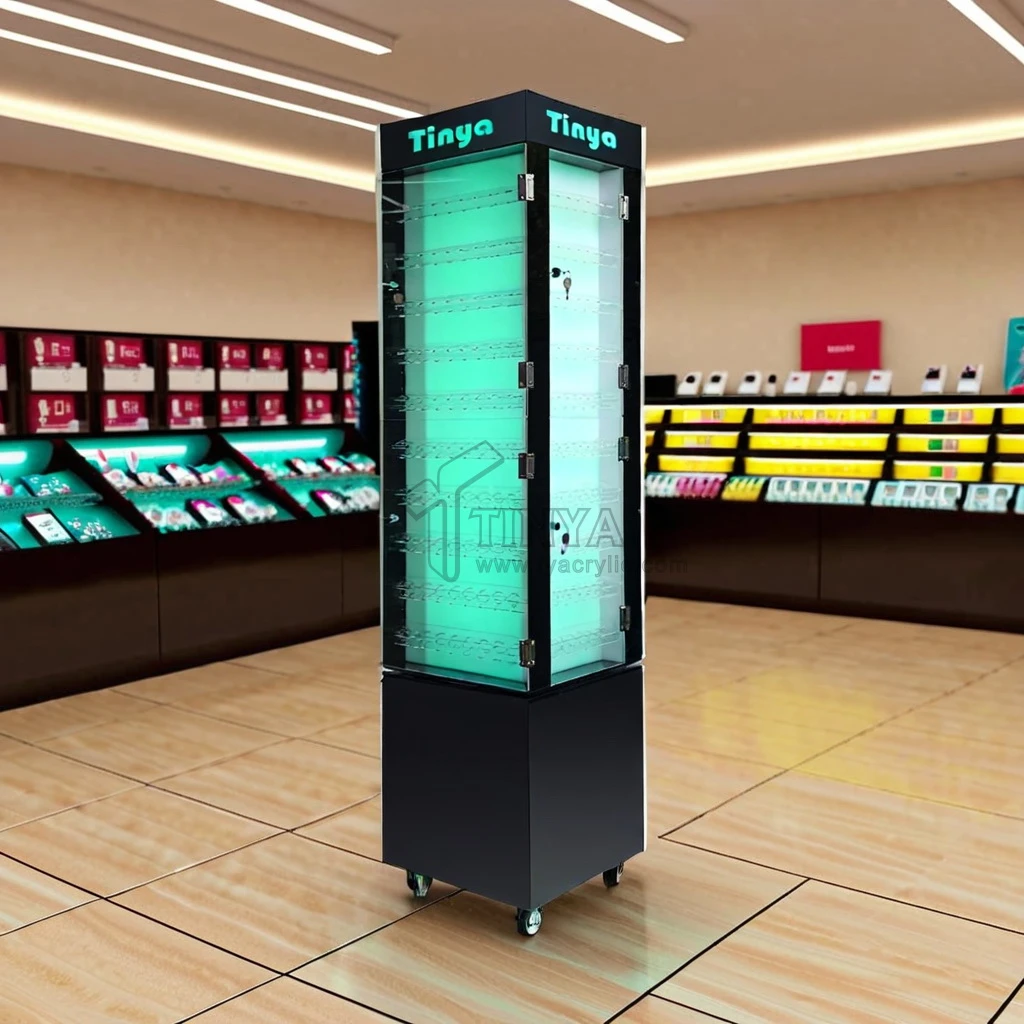
Lighting can help customers see the frame shape, color, and material more clearly.
It can also make a premium eyewear collection stand out from nearby products.
LED lighting may be placed at the top of a cabinet or along the sides.
However, brighter lighting is not always better.
Strong reflections on lenses can make the products harder to see.
Uneven light may also change how frame colors appear.
For this reason, lighting should be tested with real glasses.
Buyers should check the LED position, light color, heat, cable routing, and power supply.
If the cabinet is used in different countries, electrical requirements should be confirmed before production.
Can You Customize a Lockable Eyewear Cabinet?
Yes. A custom display manufacturer can develop a cabinet based on the eyewear products and store design.
The outside dimensions can be changed to fit the available space.
The number of shelves, frame holders, and display sections can also be adjusted.
A brand may prefer black acrylic and metal for a modern look.
Another brand may choose white panels and clear acrylic to create a brighter display.
Logo printing and branded top panels can help shoppers recognize the eyewear collection.
Some stores also want a mirror near the display so customers can check how the frames look.
The mirror should be placed where customers can use it comfortably after trying on a pair.
For large retail projects, the design should be easy to repeat across different store locations.
What Should Wholesale Buyers Check Before Ordering?
A display sample should be reviewed before mass production.
Buyers should check the cabinet dimensions and make sure every frame fits the selected holder.
The door and lock should be tested several times.
For rotating displays, the movement should be smooth and stable.
The cabinet should remain steady when workers open it or remove products.
Surface quality is also important.
Clear acrylic panels should be clean, and exposed edges should be smooth.
If the cabinet includes LED lighting, the electrical parts should be tested before packing.
Export packaging must protect the corners, transparent panels, and hardware.
For large cabinets, a knock-down structure may help reduce shipping space when it can be designed safely.
The goal is to create a display that looks good in the store and works well for daily use.
Frequently Asked Questions
What is a lockable eyewear display cabinet?
It is a retail display with a transparent viewing area and a lockable opening. It is used to organize eyewear while controlling product access.
Are lockable eyewear cabinets suitable for sunglasses?
Yes. They can be used for premium sunglasses, designer frames, and other eyewear products.
Can acrylic be used for a lockable display cabinet?
Yes. Acrylic can be used for transparent panels, shelves, and frame holders. Other materials may be added for structural support.
Can I add LED lighting to an eyewear cabinet?
Yes. LED lighting can be included in suitable custom designs, with the final electrical requirements confirmed during development.
Can the cabinet be customized for different frame sizes?
Yes. Shelf spacing, frame holders, and cabinet dimensions can be designed around the products.
Can I order lockable eyewear display cabinets in bulk?
Yes. TINYA supports custom OEM and ODM production for business customers. Our standard MOQ is 50 pieces.
Custom Eyewear Display Solutions from TINYA
A lockable eyewear display cabinet should help protect products without making them difficult to view.
It should also be stable, easy for staff to use, and suitable for the store's overall style.
TINYA Acrylic is a custom retail display manufacturer in Shenzhen, China, with manufacturing experience since 2005.
We help eyewear brands, wholesalers, and retail chains develop custom acrylic and mixed-material displays.
Our services include design support, sample development, logo printing, production, inspection, and export packaging.
All our displays are made to order rather than sold from ready stock.
If you need a custom lockable eyewear display cabinet, share your frame dimensions, preferred cabinet design, and order quantity.
Our team can help develop a display solution for your eyewear brand.