

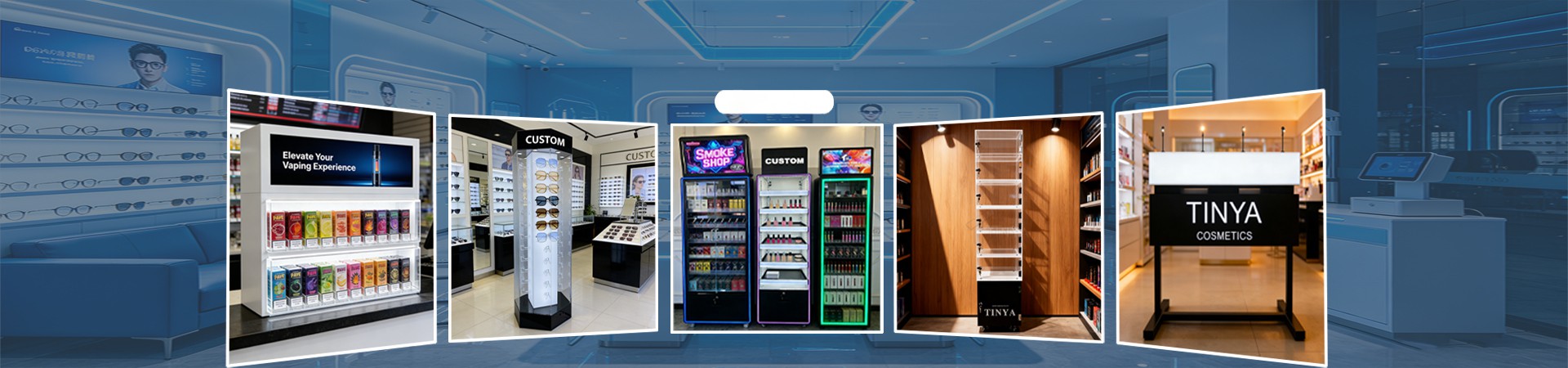
Modern displays are designed not only for aesthetics, but also for functional reliability and visual appeal. For trade shows, retail environments or exhibitions, these stands are important marketing tools that directly impact brand perception and customer engagement. Over-emphasizing decorative elements such as lighting, stickers or mechanical actuators can compromise durability, safety and cost-effectiveness. Below, we analyze common design enhancements, their limitations, and strategic alternatives to achieve the best results.
1. Integrated lighting systems


Lighting has always been a popular way to enhance product visibility. Technologies such as LED strips, neon lights or backlit panels can significantly enhance the appeal of a display. However, integrated lighting requires careful consideration of the operating environment:
1) Frequent handling or harsh environments
2) Vibration/shock risk: Air freight and repeated transportation (e.g. trade show logistics) can subject displays to forces exceeding 4G, which can cause lights to fall off, circuits to become damaged or shorted.
3) Humidity and weather exposure: Outdoor or high-humidity environments (e.g., rainy exhibitions) require IP65-rated waterproof fixtures, which add 25-40% to the cost.
4) Data-driven reliability issues: According to industry surveys, acrylic displays with recessed lighting have a 10% higher repair rate due to circuit failure.
Minimalist design requirements
Material-centric displays: Products that emphasize textures (e.g., handcrafted wood, brushed metal, or gemstones) can create visual clutter when over-lit.
Design philosophy:
Scandinavian simplicity: Neutral tones and clean lines clash with over-lighting.
Wabi-sabi aesthetic: Raw, imperfect materials lose authenticity under artificial brightness.
Budget and usage constraints
Cost overruns: Custom electrical layouts and recessed lighting troughs add 30-50% to the expense and are often impractical for short-term settings such as temporary stores.
Poor ROI: Temporary displays rarely justify the investment in integrated lighting.
Strategic Solutions
Choose modular, removable lighting fixtures (e.g., magnetic LED light strips) for easy repair and reuse.
For material-centric displays, prioritize ambient lighting over direct lighting.
Use battery-powered spotlights to avoid complex wiring in portable setups.
2. Custom Sticker Applications


Branded stickers offer a cost-effective way to reinforce identity. Their effectiveness depends on substrate compatibility and environmental factors:
Major Limitations
1) Textured or embossed surfaces
Raised patterns, 3D engravings, or grooves prevent adhesive films from lying flat, leading to bubbles, peeling, or tears.
2) Curved or angled displays
Cylindrical or wavy mounts challenge standard sticker adhesion, causing edge lift and reduced lifespan.
3) Outdoor durability issues
UV exposure can fade colors within months, while thermal expansion can weaken adhesives, especially in climates with daily temperature differences >30°C.
Specialty Alternatives
UV-resistant vinyl wraps with contour-cut technology for curved surfaces.
Laser engraving or sublimation printing for permanent, texture-compatible branding.
3M™ VHB Tape for high-stress applications that require repositionability.
3. Automatic Product Pushers


Mechanical pushers simplify the replenishment process and maximize front-end product visibility. Their deployment requires rigorous compatibility evaluation:
Product Limitations
1) Fragile or irregularly shaped items
2) Delicate products (e.g., glassware, ceramics) are at risk of breakage from the pusher mechanism.
3) Asymmetrical packaging (e.g., conical bottles, soft bags) can cause jamming or misalignment.
Environmental Sensitivity
Dusty (e.g., hardware stores) or humid environments (e.g., refrigerated areas) accelerate wear on pusher assemblies.
Optimization Methods
Soft-touch pushers with silicone or foam contact points are suitable for fragile goods.
Gravity feed systems are suitable for irregularly shaped items and eliminate mechanical complexity.
IoT-enabled sensors can trigger manual replenishment alarms, reducing reliance on pushers.
To balance form and function, designers must:
Audit usage scenarios: Assess shipping frequency, environmental stressors, and product fragility.
Embrace modularity: Use interchangeable components to accommodate the entire campaign.
Leverage data: Reference failure rate studies (e.g., 10% circuit failure in an illuminated acrylic stand) to justify material or technology choices.