

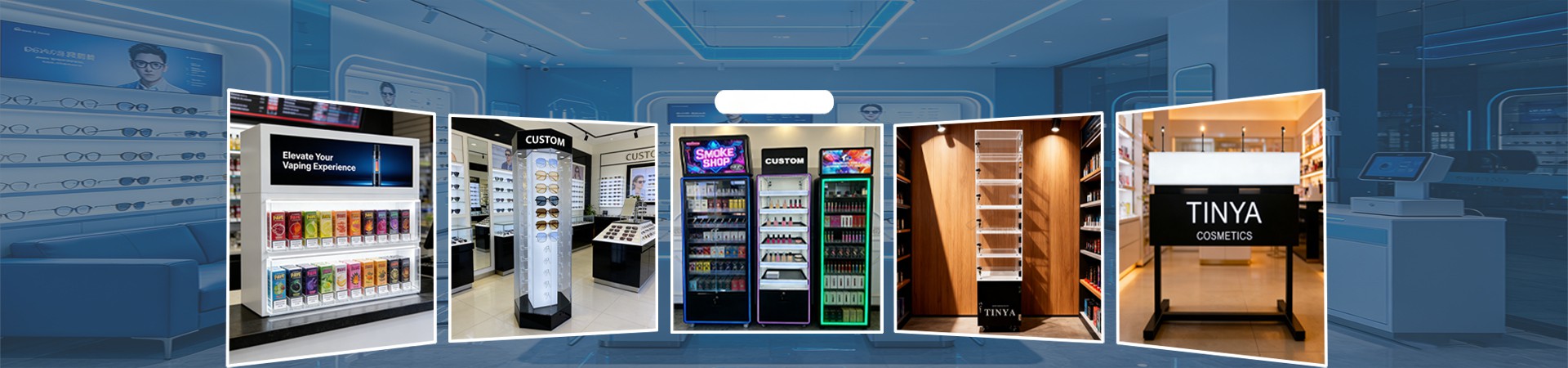

A well-designed convenience store display rack can improve product visibility, organize limited retail space, and make daily restocking easier. For convenience stores, gas stations, mini markets, and small retail chains, the right display rack is not only a storage fixture but also an important merchandising tool.
However, wholesale buyers usually need to confirm much more than appearance before placing an order. Size, material, load capacity, product compatibility, customization, packaging, and shipping all affect whether a retail display works well in a real store.
This guide answers the most common questions buyers ask when sourcing custom convenience store display racks from a manufacturer.
What Products Can a Convenience Store Display Rack Hold?
A convenience store display rack can be designed for many types of retail merchandise, including snacks, beverages, candy, packaged food, electronics accessories, personal care products, tobacco-related packaged products, and other small consumer goods.
The most important factor is the size and weight of the products being displayed.
For lightweight products such as candy, small boxes, or packaged accessories, acrylic or lightweight metal structures may be sufficient. For bottled drinks, larger packaged products, or heavier merchandise, reinforced metal shelves or mixed-material construction may be more suitable.
For custom projects, buyers should provide the product dimensions, approximate weight, and expected quantity per shelf. This allows the manufacturer to calculate the correct shelf spacing, depth, and load-bearing structure.

What Material Is Best for a Convenience Store Display Rack?
There is no single material that is suitable for every convenience store display.
Acrylic is commonly used when product visibility and a clean appearance are important. Metal offers better strength for heavier products or larger floor-standing racks. MDF or wood-based panels are often used when the retailer wants a more premium or branded appearance.
Many commercial displays use a combination of materials.
For example, a convenience store display rack may use a metal frame for strength, acrylic shelves for product visibility, and printed PVC or MDF panels for branding.
| Material | Main Advantage | Common Application |
|---|---|---|
| Acrylic | Clear appearance and strong product visibility | Candy, cosmetics, accessories, small packaged goods |
| Metal | High load capacity and durability | Drinks, snacks, heavy packaged products |
| MDF | Premium appearance and easy branding | Branded retail displays and promotional fixtures |
| Acrylic + Metal | Balance of visibility and strength | Custom convenience store displays |
| PVC / Printed Panels | Lightweight and suitable for graphics | Promotional side panels and headers |
The final material should be selected according to the product weight, display location, required appearance, and budget.
How Do I Choose the Right Size for a Convenience Store Display Rack?
The correct rack size depends on both the merchandise and the available retail space.
For countertop displays, compact dimensions are usually preferred because convenience store counters often have limited space. For floor-standing displays, the rack should provide enough product capacity without blocking aisles or customer movement.
Before production, buyers should provide the available installation area and the dimensions of the products.
A manufacturer can then adjust the overall width, depth, shelf height, and number of tiers according to the actual merchandising requirement.
For stores with several branches, it is also helpful to standardize one display size so that the same rack can be used across different locations.

Can the Shelf Spacing Be Customized?
Yes. Shelf spacing is one of the most commonly customized parts of a convenience store display rack.
Fixed shelves are suitable when the store always displays the same product size. Adjustable shelves provide more flexibility when product packaging changes frequently.
For retailers selling several product sizes, adjustable shelving can reduce the need to replace the entire display when new products are introduced.
During the design stage, the manufacturer normally needs the maximum product height and the number of shelves required. This information helps ensure there is enough clearance for customers to easily remove and replace products.

How Much Weight Can a Convenience Store Display Rack Support?
The load capacity depends on the rack material, shelf thickness, structure, overall dimensions, and connection method.
Acrylic displays are generally suitable for light to medium products. Metal racks can support significantly heavier merchandise when designed with reinforced shelves and frames.
Buyers should avoid selecting a rack based only on appearance.
For commercial projects, the manufacturer should know the estimated weight placed on each shelf before the design is finalized. This allows the structure to be reinforced where necessary and reduces the risk of shelf bending during long-term retail use.
Can I Add My Logo and Brand Graphics?
Yes. Custom branding is one of the main advantages of ordering a display directly from a manufacturer.
A convenience store display rack can include logos, advertising graphics, product information, promotional slogans, or brand colors.
Depending on the material and design, branding can be applied through UV printing, screen printing, stickers, printed panels, engraving, or other printing methods.
Logo placement is commonly added to the header, side panels, front shelf edge, or base.
For branded retail campaigns, buyers should provide high-resolution logo files and any required Pantone or color references so that the display can match existing brand guidelines.

Can the Display Rack Include LED Lighting?
Yes. LED lighting can be added when stronger product visibility is required.
LED strips are often installed along shelf edges, side panels, headers, or underneath acrylic panels. This can be useful for electronic accessories, cosmetics, premium packaged products, or branded promotional displays.
For international orders, buyers should confirm the destination country so that the correct voltage, plug type, and power supply can be prepared.
If lighting is not essential, a non-LED version may reduce production cost and simplify installation.
Should I Choose a Countertop or Floor-Standing Display?
The choice depends mainly on product size, quantity, and store layout.
A countertop convenience store display rack is more suitable for small products, impulse-buy items, and merchandise placed near the checkout area. It is often used for candy, small accessories, personal care products, and promotional products.
A floor-standing rack provides more capacity and is better suited for packaged snacks, beverages, larger retail products, or product categories that need their own merchandising area.
For chain stores, buyers sometimes use both formats: a larger floor display for main inventory and smaller countertop displays near the cashier.

Can Convenience Store Display Racks Be Shipped Knocked Down?
Yes. Knock-down construction is often recommended for large-volume international orders.
A KD display rack can be packed flat, which helps reduce carton size and shipping volume. This is particularly useful for floor-standing convenience store display racks where fully assembled shipping can significantly increase freight costs.
The structure should still be easy for store staff to assemble.
Manufacturers can provide screws, fittings, assembly instructions, and numbered parts to make installation easier after delivery.
For large retail programs, shipping efficiency should be considered during the design stage rather than after the rack has already been finalized.
What Information Should I Send Before Requesting a Quote?
A more accurate quotation depends on how much project information the buyer can provide.
The most useful information includes the product size, product weight, estimated quantity per rack, preferred display size, material preference, logo requirements, required order quantity, and shipping destination.
Reference images are also helpful.
If the buyer does not yet have a finished design, a manufacturer can usually create a structure based on the product dimensions and intended retail environment.
The more accurate the initial information is, the fewer design changes will be required before production.
What Is the Typical MOQ for a Custom Convenience Store Display Rack?
The MOQ depends on the level of customization, material, manufacturing process, and display size.
Simple acrylic countertop displays usually have a lower production threshold than complex floor-standing displays with metal structures, lighting, printed panels, or multiple components.
For a new project, some buyers begin with a sample before confirming the bulk order.
This allows them to check the actual dimensions, product fit, printing, stability, and overall appearance before mass production.
For distributors, retail chains, and branded merchandising programs, bulk production usually offers a lower unit cost because tooling, printing, packaging, and setup costs are distributed across a larger quantity.
How Long Does Custom Production Take?
Production time depends on the display complexity and order quantity.
A simple convenience store display rack can normally move through design approval and production relatively quickly, while displays involving metal fabrication, LED lighting, custom printing, or multiple materials may require more time.
The process usually includes drawing confirmation, sample approval, material preparation, production, printing, assembly, inspection, and packaging.
Buyers with a fixed retail launch date should inform the manufacturer early so that the sample and mass-production schedule can be planned accordingly.
FAQ
Can a convenience store display rack be customized for my products?
Yes. The rack dimensions, shelf spacing, number of tiers, material, color, logo, and overall structure can be customized according to your product size and retail requirements.
Can I order a sample before mass production?
Yes. A sample is recommended for custom retail display projects because it allows the buyer to check product fit, stability, printing quality, and overall appearance before confirming the bulk order.
Can you make a rack based only on my product dimensions?
Yes. If you provide the product width, depth, height, weight, and expected quantity, a manufacturer can design a suitable convenience store display rack around those specifications.
Can the display rack have wheels?
Yes. Casters can be added to larger floor-standing racks when the retailer needs to move the display frequently. Lockable wheels are usually preferred for store environments.
Can different materials be combined in one display?
Yes. Acrylic, metal, MDF, PVC, and printed panels can be combined in one display depending on the required structure and visual effect.
Can the rack be packed flat for international shipping?
Yes. Many floor-standing display racks can be designed with knock-down construction to reduce packaging volume and international freight costs.
Can you print our company logo on the display?
Yes. Custom logo printing, branded graphics, colors, headers, and promotional panels can be added according to the buyer's artwork and branding requirements.
What should I provide to get an accurate quotation?
For the most accurate quotation, provide your product dimensions, approximate product weight, preferred rack size, required quantity, logo file, reference design if available, and delivery country or postal code.