

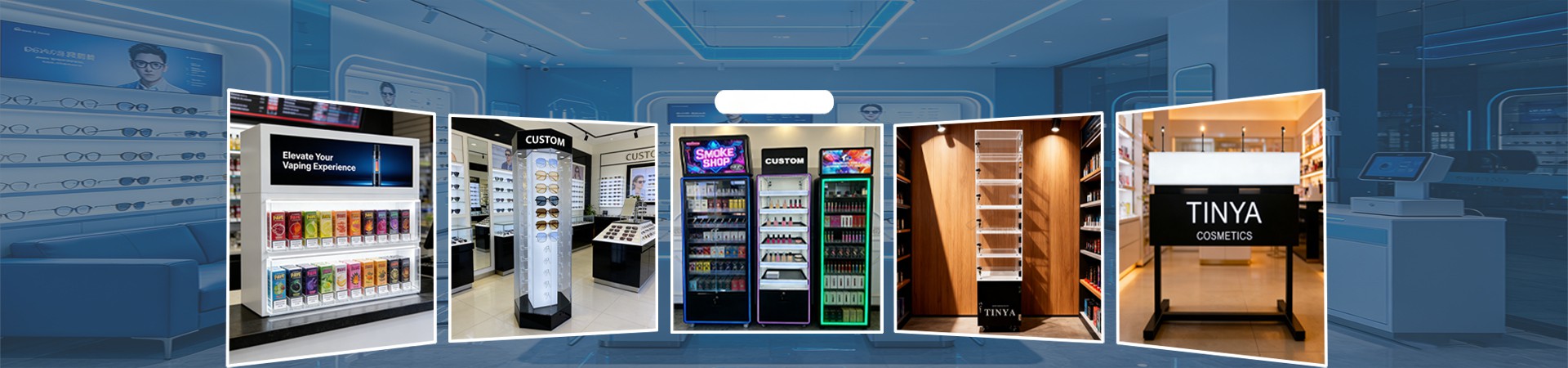


In a crowded retail environment, having a good product is only part of the challenge. The product must first attract attention, communicate its value and give shoppers a reason to stop.
This is where a promotional display stand becomes important.
A well-designed promotional display is more than a shelf used to hold merchandise. It combines product presentation, brand communication and retail merchandising in one physical structure. Whether it is positioned on a checkout counter, placed at the entrance of a store or used as a floor-standing promotional unit, the display becomes part of the customer's first impression of the product.
For brands, distributors and retailers, this means the design of an advertising display stand can directly influence how clearly a product is presented, how easily customers understand a promotion and how consistently the brand appears across different stores.
However, developing an effective display requires more than adding a logo to an existing rack. Product dimensions, store location, display capacity, material, lighting, assembly, packaging and transportation all need to be considered before production begins.
This guide explains how buyers can plan and source a custom promotional display stand for real retail environments.
What Is a Promotional Display Stand?
A promotional display stand is a retail fixture designed to present products while simultaneously communicating a brand, campaign, product launch or promotional message.
Unlike a standard storage shelf, its purpose is not simply to organize products. The display must make the merchandise easier to notice and help shoppers understand what is being promoted.
For example, a cosmetics brand launching a new skincare line may use a branded countertop display with product testers, printed graphics and an illuminated logo. An electronics company may use a freestanding display containing smartphones, headphones or smart watches, while a beverage brand may use a multi-tier promotional rack designed around bottle dimensions and brand colors.
The exact structure varies, but the principle remains the same: the display brings the physical product and the advertising message together.
This is why terms such as promotional display stand, advertising display stand, branded display stand and retail promotional display are closely related. The differences usually come from how and where the display is used rather than from a completely different product category.
Why Promotional Displays Matter in Physical Retail
Online advertising can bring shoppers to a brand, but the final purchase decision often takes place when the customer is standing directly in front of the product.
At that moment, packaging competes with surrounding products, shelves, signage, promotions and other visual information.
A promotional display creates a dedicated visual zone around the product.
Instead of allowing merchandise to disappear into a standard retail shelf, the stand can use height, lighting, color, product spacing and printed graphics to separate the promoted products from their surroundings.
This is especially valuable for new products.
When customers are unfamiliar with a brand or product category, the display can explain the product without requiring a salesperson. A headline, graphic panel, logo, product arrangement or short promotional message can communicate what the product is and why the customer should pay attention.
For established brands, displays serve another purpose: consistency.
If a brand supplies hundreds of retail stores, a customized display helps ensure that products appear in a similar way in every location. The dimensions, logo position, lighting and product arrangement can all remain consistent even when the surrounding store environments are different.

Promotional Display Stand vs Ordinary Retail Display Rack
Although the two products may look similar, they are normally designed around different priorities.
| Comparison | Promotional Display Stand | Standard Retail Display Rack |
|---|---|---|
| Primary purpose | Product promotion and brand communication | Product organization and storage |
| Branding | Usually highly customized | Often limited or generic |
| Logo | Commonly integrated into the structure | Optional |
| Promotional graphics | Frequently included | Usually minimal |
| Product layout | Designed around specific SKUs | More universal |
| Lighting | Often available | Less common |
| Materials | Acrylic, metal, MDF, PVC or mixed materials | Commonly metal, plastic or wood |
| Retail duration | Campaign, launch or permanent use | Usually long-term |
| Customization level | High | Low to medium |
| Typical buyer | Brand, distributor, marketing agency, retailer | Retailer or store fixture buyer |
For brands running a specific promotion, a generic rack may technically hold the products, but it usually cannot communicate the same brand message.
A custom promotional display stand is designed around both the product and the campaign.
Start the Design With the Product, Not the Stand
One of the most common sourcing mistakes is choosing a display style before confirming the products that will go inside it.
A display may look attractive in a rendering but still fail in actual retail use if the shelves are too close together, the products fall over or staff cannot restock the unit easily.
For this reason, the design process should begin with the merchandise.
The manufacturer needs to understand the product width, depth and height as well as the number of pieces that should be displayed at one time. Packaging dimensions are particularly important because the display normally holds the packaged retail product rather than the product itself.
A 60 mm bottle, for example, may become an 80 mm-wide retail package after boxing. Designing around the bottle measurement would make the final display unusable.
The same principle applies to cosmetics, vape products, electronics, mobile accessories, perfume, watches and packaged consumer products.
Clear product dimensions allow the designer to calculate shelf spacing, product capacity and overall display size before manufacturing starts.

Countertop or Floor-Standing Promotional Display?
Placement has a major influence on the structure.
A countertop promotional stand works best when the product is relatively small and the purchase decision happens near a service desk, checkout area or product counter.
Cosmetics, perfume, electronic accessories, small packaged goods and impulse-purchase items often fit this format because customers are already close enough to examine the products.
A floor-standing promotional display stand offers much more visual space.
It can accommodate several shelves, larger branding panels and greater stock capacity. For stores where the display must be visible from a distance, the taller structure also gives the brand more space for logos and promotional graphics.
The trade-off is transportation volume.
A fully assembled floor display may occupy significant carton space, which can substantially affect international freight costs. For export projects, manufacturers may therefore recommend a knock-down or partially detachable structure.
This allows the stand to be packed flatter without sacrificing the final visual effect after assembly.
Choosing the Right Material for a Promotional Display Stand
Material affects appearance, durability, cost, product weight and the manufacturing process.
Acrylic is widely used when the brand wants a clean, modern appearance and strong product visibility. Clear acrylic allows packaging to remain visible without heavy structural panels blocking the product.
Colored, frosted and printed acrylic can also be combined with transparent sections to create stronger branding.
Metal is suitable when the display carries heavier merchandise or requires a larger structural frame. Powder-coated steel can support substantial loads and is frequently combined with acrylic shelves or advertising panels.
MDF provides another option for larger branded displays. It offers a solid surface for paint, graphics and decorative finishing and works well when transparency is not an important requirement.
Many commercial displays therefore use several materials instead of relying on one.
For example, a custom advertising display stand might use a metal frame for strength, acrylic product trays for visibility and an MDF base for stability. LED lighting and printed graphics can then be integrated into the same structure.
The correct material combination should depend on the expected load, retail environment, target appearance and budget.

Why Acrylic Works Well for Branded Promotional Displays
Acrylic has several characteristics that make it particularly suitable for promotional merchandising.
Its visual transparency allows shoppers to see both the packaging and the product arrangement clearly. This is particularly valuable for cosmetics, perfume, consumer electronics and premium products where packaging plays an important role in purchasing decisions.
Acrylic is also highly customizable.
Panels can be cut into different shapes, bent, printed, polished and combined with other materials. Brand logos can be printed directly onto the acrylic, while thicker panels can be laser engraved or used as illuminated logo elements.
Because acrylic looks cleaner and more premium than many temporary plastic or cardboard structures, it can also be used for longer retail campaigns.
This makes an acrylic promotional display stand suitable for brands that need something between a short-term cardboard promotional display and a permanent heavy store fixture.
Branding Should Be Part of the Structure
Adding a logo at the end of the design process is not the same as creating a branded display.
Brand identity should influence the proportions, materials and visual hierarchy from the beginning.
A premium cosmetics company, for example, may require clean white acrylic, minimal graphics and subtle illumination. A youth electronics brand may prefer brighter graphics, colored acrylic and RGB lighting. A luxury perfume brand may combine acrylic with metallic accents or mirrored surfaces.
The logo also needs to be positioned where customers can actually see it.
On a countertop stand, the logo might work best on the front base or rear header panel. On a floor display, a larger illuminated header can communicate the brand from several meters away.
Color consistency is equally important.
When printing brand colors onto acrylic, PVC or other panels, buyers should provide accurate artwork and preferably Pantone, CMYK or other production references when color matching is important.
The goal is for the physical branded display stand to look like a natural extension of the brand's packaging and advertising rather than a separate store fixture.
How Product Capacity Changes the Display Design
More capacity does not automatically mean a better display.
A stand that holds too many products may look crowded and make individual items difficult to see. A stand with too little stock may require constant replenishment and look empty during busy retail periods.
The appropriate capacity depends on store traffic, SKU count, product size and replenishment frequency.
If one display needs to present several flavors, colors or product variations, each SKU should have a clearly defined position.
This helps shoppers compare products and also makes restocking easier for store staff.
For products with similar packaging, shelf labels or printed graphics can help differentiate each SKU.
For packaged goods that sell quickly, gravity-feed channels or pusher systems may also be incorporated into the design so products remain aligned at the front of the shelf.
The product capacity should therefore be calculated together with the retailer rather than decided purely from available stand dimensions.
The Role of LED Lighting in Promotional Displays
Lighting can increase visual impact, but it needs a purpose.
A simple illuminated logo can make the brand more visible without changing the entire display. Edge-lit acrylic panels can highlight printed graphics, while shelf lighting can direct attention toward the products.
For electronics or premium cosmetics, lighting also helps create a more sophisticated presentation.
However, adding LEDs introduces additional design considerations.
Cable routing must be planned so wires do not interfere with products or customers. Power adapters and voltage requirements also need to match the destination market.
For international retail programs, buyers should confirm where the displays will be installed before electrical components are finalized.
A well-designed LED system should enhance the merchandise while keeping wiring and power components as unobtrusive as possible.

Permanent Displays and Temporary Promotional Campaigns Need Different Designs
The expected retail life of a display has a major influence on construction.
A stand intended for a three-week product promotion does not necessarily require the same structure as one expected to remain in a store for several years.
Temporary campaigns may prioritize lightweight construction, fast assembly and low shipping cost.
Long-term promotional displays need greater attention to surface durability, structural strength, hardware and repeated restocking.
For a permanent display, moving components such as doors, drawers, locks and rotating parts must also withstand frequent operation.
Communicating the expected usage period to the manufacturer helps prevent both under-engineering and unnecessary cost.
Promotional Display Formats for Different Retail Programs
| Retail Requirement | Recommended Display Format | Main Design Priority |
|---|---|---|
| Checkout promotion | Countertop display | Compact footprint and product visibility |
| New product launch | Branded promotional display stand | Strong graphics and clear product communication |
| Large retail rollout | Modular display system | Consistency and easy installation |
| Cosmetics promotion | Acrylic countertop display | Tester access and premium appearance |
| Electronic products | LED advertising display stand | Security, power management and branding |
| High-capacity retail | Floor-standing display | Stock capacity and structural stability |
| Seasonal campaign | Detachable promotional display | Easy transport and assembly |
| Premium brand launch | Acrylic and metal display | Finishing, lighting and visual quality |
| Trade show promotion | Portable modular display | Reusability and transport efficiency |
There is no single structure that suits every campaign. The best solution is usually developed around the product, retail location and expected duration.
Designing for Easy Assembly and International Shipping
A beautiful display can become expensive if transportation is ignored until the project is finished.
This is particularly important with large floor-standing displays.
Freight charges are influenced not only by weight but also by carton volume. A fully assembled display with large empty spaces inside the carton can therefore be much more expensive to ship than a carefully designed knock-down unit.
Detachable shelves, removable headers and modular side panels can reduce the packed volume.
However, assembly cannot become overly complicated.
Retail stores may have dozens or hundreds of units to install, often without professional installation teams. Connections should therefore be intuitive and assembly instructions should be easy to understand.
A successful knock-down structure balances shipping efficiency with installation convenience.
What Determines the Cost of a Custom Promotional Display Stand?
Buyers sometimes send only a reference picture and ask for a unit price.
That is rarely enough information for an accurate quotation.
Two stands with similar external dimensions can have very different production costs depending on materials, panel thickness, hardware and finishing.
| Cost Factor | How It Affects the Project |
|---|---|
| Overall size | Larger stands use more material and increase packaging volume |
| Material | Acrylic, metal and MDF have different fabrication costs |
| Material thickness | Thicker panels increase weight and material consumption |
| Number of shelves | More shelves require additional processing and assembly |
| Printing | Multi-color graphics and large print areas increase production work |
| LED lighting | Adds electrical components and assembly requirements |
| Hardware | Locks, hinges, casters and magnets affect both cost and function |
| Structure | Knock-down or complex modular designs require engineering |
| Packaging | Export protection may require foam, cartons or wooden cases |
| Quantity | Production setup costs are distributed across the order quantity |
A useful quotation should therefore be based on dimensions, materials, quantity, branding requirements and expected destination.
If the buyer has a target budget, sharing it during the design stage can also help the manufacturer choose a more appropriate structure before a sample is made.
Why a Prototype Matters Before Mass Production
Rendering is useful for confirming appearance, but it cannot fully demonstrate how a physical display behaves.
A prototype allows the buyer to place real products onto the stand and evaluate shelf spacing, stability, product access, branding position and overall visual proportion.
This is particularly important when the design contains drawers, locks, removable parts, lighting or unusual product shapes.
The sample stage is also the appropriate time to make adjustments.
Changing a shelf height or logo position before production is relatively straightforward. Making the same change after hundreds of units have already been manufactured can become expensive.
For larger retail programs, prototype approval should therefore be treated as a production checkpoint rather than simply a visual sample.
What Buyers Should Check Before Approving Mass Production
Final approval should focus on both appearance and everyday retail use.
The products should fit naturally into the allocated spaces without being excessively tight or loose. Shelves should support the expected load and remain level. Printed branding should match the approved artwork and appear consistently positioned.
If lighting is included, brightness, cable routing, adapter specifications and switches should all be checked.
The buyer should also examine packaging.
Acrylic surfaces can be scratched if parts rub against each other during transportation, so suitable protective films and individual wrapping may be required.
For detachable displays, packaging should keep individual components organized so stores can identify the parts quickly during assembly.
These details may appear small during product development, but they have a large impact when a display program is rolled out across many retail locations.
Custom Promotional Display Stand Manufacturing for Global Retail Brands
A successful promotional display project connects several disciplines: industrial design, branding, retail merchandising, engineering and manufacturing.
For this reason, the manufacturing partner should understand more than acrylic fabrication alone.
The supplier must be able to translate product dimensions and branding requirements into a physical structure that can be manufactured repeatedly and shipped safely.
At Tinya Acrylic Display, promotional display projects can be developed around the customer's actual merchandise, brand artwork and retail requirements.
Depending on the application, displays can combine acrylic, metal, MDF, PVC, printed graphics, lighting, locks, wheels and detachable structures.
The design can begin with a reference image, product dimensions or an existing concept. A 2D or 3D design can then be reviewed before prototyping and mass production.
For retailers and brands purchasing in volume, this approach provides more flexibility than selecting a generic display and attempting to adapt the merchandise around it.
Frequently Asked Questions About Promotional Display Stands
What is a promotional display stand?
A promotional display stand is a retail fixture that presents products while communicating a brand, product launch or promotional campaign. It can include shelves, product holders, logos, graphics, lighting and other branding features. Countertop and floor-standing structures are both commonly used depending on product size and retail placement.
What is the difference between a promotional display stand and an advertising display stand?
The two terms frequently overlap. A promotional display stand usually emphasizes presenting physical products as part of a retail promotion, while an advertising display stand may place more emphasis on graphics, messaging or brand communication. Many custom retail displays perform both functions simultaneously.
Can a promotional display stand be customized with our logo?
Yes. Logos can be integrated through UV printing, silk-screen printing, laser engraving, stickers, printed graphic panels or illuminated logo elements. The appropriate method depends on the material, artwork and required visual effect.
What materials can be used for promotional displays?
Promotional displays can be manufactured from acrylic, metal, MDF, PVC or combinations of these materials. Acrylic works particularly well when transparency and premium product presentation are important, while metal can provide greater structural strength for heavy or large displays.
Can you make a floor-standing promotional display?
Yes. Floor-standing displays can include multiple shelves, branding headers, storage areas, casters, lighting and detachable structures. Dimensions and product capacity should be designed around the actual retail products.
Can promotional display stands include LED lighting?
Yes. LEDs can be used for illuminated logos, shelves, edge-lit acrylic panels or decorative lighting. Voltage, adapters and electrical requirements should be confirmed according to the destination market.
What information should I provide for a quotation?
The most useful information includes the product dimensions, required quantity, expected display capacity, reference design, logo artwork, material preference and delivery destination. If the final design has not yet been confirmed, product photos and approximate requirements can be used as the starting point.
Should I make a sample before placing a bulk order?
A sample is recommended for customized retail displays, particularly when the project contains multiple shelves, custom product holders, lighting, locks or detachable components. It allows the product fit, structure and appearance to be confirmed before mass production.
Can the display be designed as a knock-down structure?
Yes. Large advertising and promotional displays can often be redesigned with detachable components to reduce packaging volume and international shipping costs. The final structure should still remain easy for retail staff to assemble.
What products are suitable for a custom promotional display stand?
Promotional display stands can be developed for cosmetics, perfume, skincare, mobile accessories, consumer electronics, watches, eyewear, beverages, vape products, packaged consumer goods and many other retail categories. The display structure should be customized according to the dimensions, weight and merchandising requirements of the specific products.
Build a Promotional Display Around Your Product and Brand
A successful promotional display stand should not force a product into a standard fixture.
The better approach is to begin with the actual merchandise, retail location and campaign objective, then design the stand around those requirements.
Product capacity determines the internal layout. Brand identity influences materials and graphics. Store placement determines the overall size. Transportation requirements influence whether the structure should be assembled or detachable.
When these factors are considered together, an advertising display becomes more than a place to put products. It becomes a physical extension of the brand inside the retail environment.
If you are planning a custom promotional display stand for a new product launch, retail chain, distributor program or long-term merchandising project, send us your product dimensions, reference images, logo and expected quantity. Our team can help evaluate the structure and develop a customized display solution for your retail program.