

My Acrylic Display Stand Procurement Story
My name is John, and I manage several dozen retail vape stores across the country. For many years, our merchandising strategy relied on open displays, colorful product arrangements, and illuminated racks placed near the counter to help customers understand new flavors and device categories. But when new regulations came into effect earlier this year, everything inside our stores was forced to change. The government introduced a strict advertising ban on vape products, requiring retailers to keep all devices inside closed cabinets or fully enclosed display structures. Posters, shelf branding, and any form of open product presentation were classified as promotional displays and therefore prohibited. While the rule was clear, the impact on daily sales operations was not. Our staff still needed a way to access products quickly, explain differences to customers, and keep inventory organized, yet all of this had to be done inside a closed, non-transparent structure.


In the beginning, I thought finding a closed display stand would be straightforward. But the deeper I went into the procurement process, the more I realized I was not simply buying a physical rack. What I truly needed was a practical and compliant solution. Many suppliers I contacted were eager to sell, but very few were prepared to solve the actual problem. Several of them kept asking me what structure I wanted, whether I had a design ready, or if I could show them a sample of the kind of cabinet my stores planned to use. This made me realize that some suppliers mainly rely on copying or receiving complete instructions from buyers. In other words, they were waiting for me to tell them the answer. As a buyer dealing with urgent regulatory changes, I didn't have time to design from scratch. I needed a team capable of understanding restrictions, interpreting my needs, and proposing smart, feasible display structures.
Eventually, among the many responses, a few suppliers distinguished themselves through their willingness to think for me. Instead of asking endless questions, they offered clear ideas. One supplier, in particular, took the initiative and proposed a display structure that directly addressed the compliance challenge. It was a fully enclosed acrylic cabinet with white flip-up doors on every shelf. Each door used metal hardware to ensure a smooth opening motion, allowing store staff to lift the panel easily when customers wanted to examine a device. After the door was closed, the whole front returned to a clean, non-transparent surface that aligned with the new regulations. Even better, the supplier included simple models to illustrate how the doors operated. It was the first moment in my sourcing journey when someone provided not only a product but a genuine solution.


Once I shared the size of my various vape products-pods, disposables, starter kits, and bottled liquids-the supplier refined the internal layout to match our inventory categories. They adjusted the compartment heights, added dividers for packaging stability, and organized the shelf spacing so staff could quickly remove or restock items without causing clutter. These details gave me confidence, because a compliant display is only effective if it is practical inside the store. A cabinet that is difficult to use will disrupt workflow and reduce the speed of customer service. Acrylic proved to be particularly suitable for this type of customization. The material is flexible, lightweight, and strong enough for daily operation. It can be cut precisely according to the product sizes and adapted into many shapes, while also offering a wide choice of colors. In a situation where regulations limit creative marketing, the ability to customize structure and internal divisions becomes even more important.

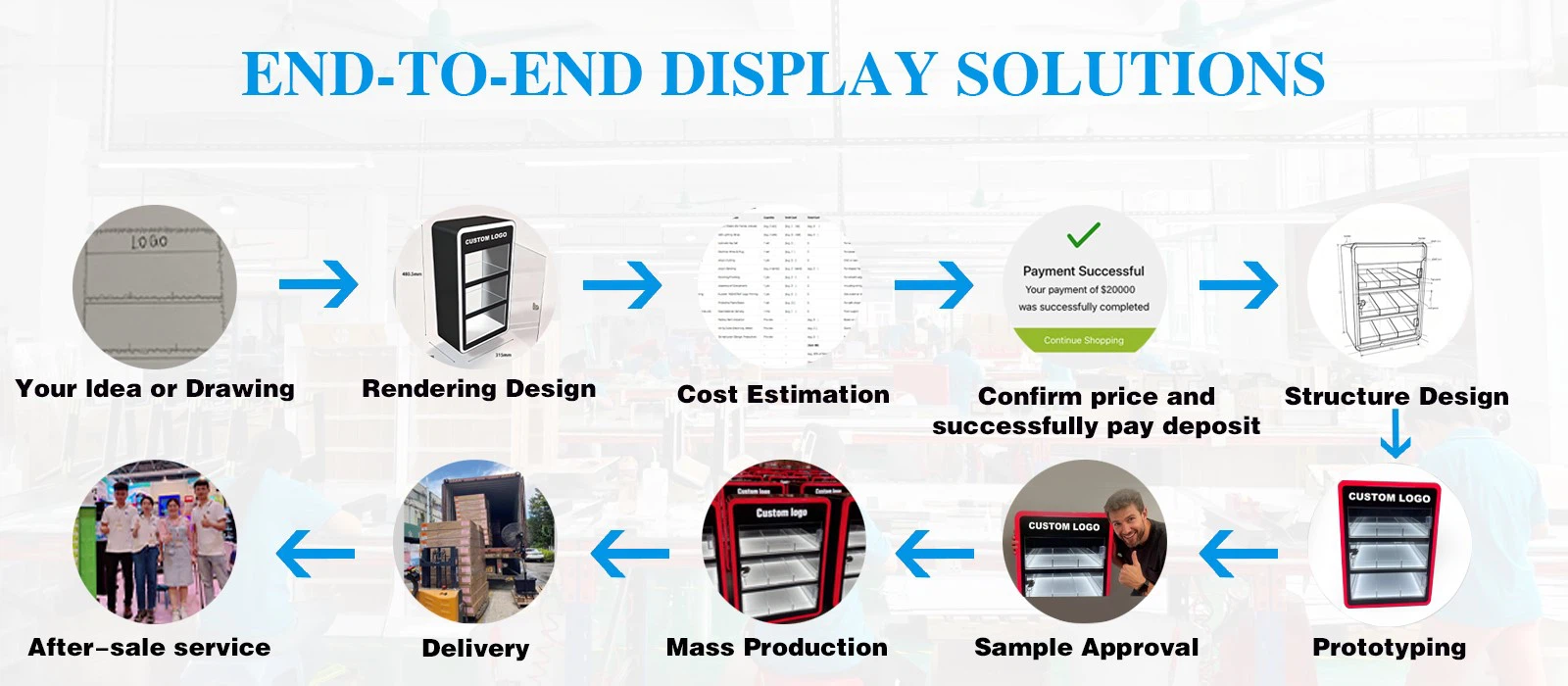
The next stage-sampling-turned out to be the most essential step. Many buyers try to avoid sampling because of cost or time pressure, but I have learned that approving a sample is the cheapest and safest part of procurement. A sample reveals details that a drawing cannot: the smoothness of the hinge movement, the precision of acrylic edges, the sturdiness of the structure, and how well the compartments actually fit the products. It also confirms the chosen acrylic thickness, color opacity, and assembly method. In my experience, correcting mistakes after mass production starts is far more costly and stressful than investing a little in a confirmed sample early on. For buyers dealing with multiple suppliers or industries where precise sizes matter, a physical or even partial sample prevents expensive errors later.
However, shipping large acrylic samples internationally can become costly. To solve this, I asked the supplier for detailed video inspections. They filmed the entire unit from multiple angles, opened and closed each door repeatedly, measured every major dimension on camera, and even placed their own devices inside the compartments to simulate real storage. This actually covered nearly everything I needed to check. In addition, I requested that they create a simple paper mockup based on my exact product sizes. This inexpensive method allowed them to test fitting and spacing without producing a full acrylic prototype. These small techniques saved time, avoided unnecessary shipping fees, and allowed me to evaluate several design adjustments before finalizing the structure.
Throughout this process, I gradually learned that selecting a supplier involves assessing more than product quality. It requires observing how the sales and engineering teams handle communication, how well they understand the situation, how quickly they respond with updated drawings, and how responsibly they manage uncertainty. A capable supplier should be able to refine ideas, solve structural concerns, interpret regulations correctly, and coordinate materials or hardware when necessary. Their behavior during these early stages is often the best indicator of how reliable they will be during long-term collaboration. Over time, I found that the supplier who had given me the most complete concept early on was also the one who consistently provided structured communication, production updates, and professional advice.
Once the sample was approved, mass production began. To maintain full transparency, I asked the sales representative to share every major phase of production. This included acrylic sheet cutting, assembly line setup, the first finished unit, mid-stage quality checks, and packaging tests. Frequent updates might seem demanding, but in reality, any responsible factory should already have these steps documented. And for buyers like me managing multiple retail stores, knowing the progress ensures smoother scheduling for installations and store transitions. It also provides the opportunity to detect small issues early before they become large-scale problems.
When the final acrylic displays were delivered and installed across my stores, the results were reassuring. Staff could open each flip-up door quickly when customers asked about a product, and the overall organization inside the cabinet improved compared to our previous setups. Even though the displays had to remain closed in compliance with the new regulations, the structure made it possible to offer an orderly, consistent, and efficient customer experience. Most importantly, we remained compliant without compromising operational flow.
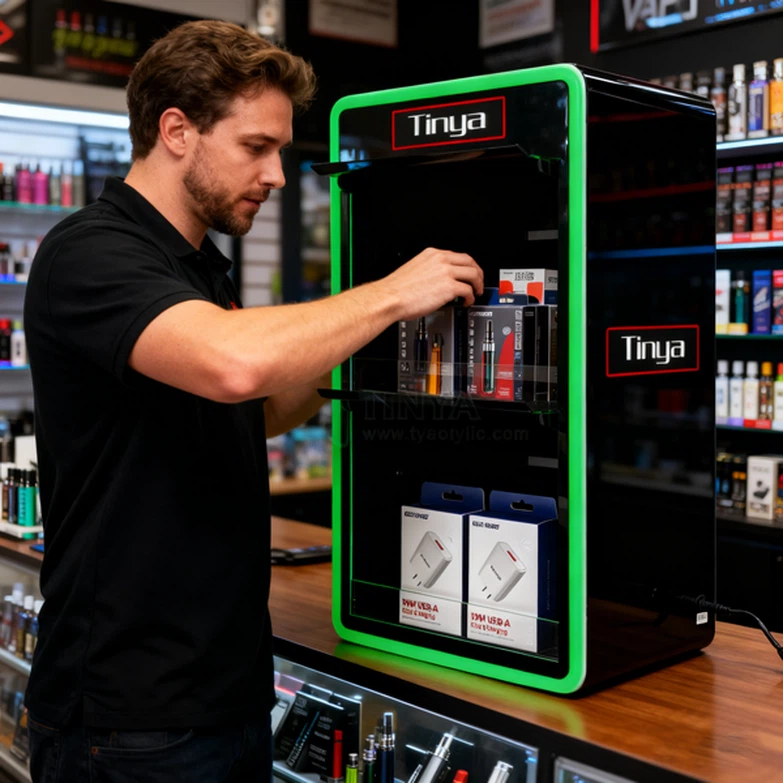


Looking back, I realized that the true value of the procurement journey was not simply about obtaining a compliant cabinet design. It was learning how to evaluate suppliers by their thinking ability, their problem-solving mindset, and their willingness to guide buyers through detail-oriented decisions. A display stand may seem like a simple product, but when regulations and store operations intersect, the difference lies in the solution rather than the material alone. Every step-from idea generation to sampling to production-reveals whether a supplier is capable of long-term cooperation.
If you are facing similar questions about display structures, enclosed designs, compliance-based layouts, or customized acrylic solutions, we can share additional experience, suggestions, and procurement insights. Every scenario is different, and the right approach depends on understanding your products, your regulations, and your store workflow. We welcome discussions and are always open to exchanging practical knowledge that can help others make better decisions in their own display projects.