


A smartwatch may be compact, but displaying it effectively in a retail store involves more than placing it on a small stand. Customers need to see the screen, examine the case and strap, compare different models and, in many stores, try the watch on. At the same time, the retailer must keep demo devices charged, control loose cables, protect valuable products and maintain a clean branded counter.
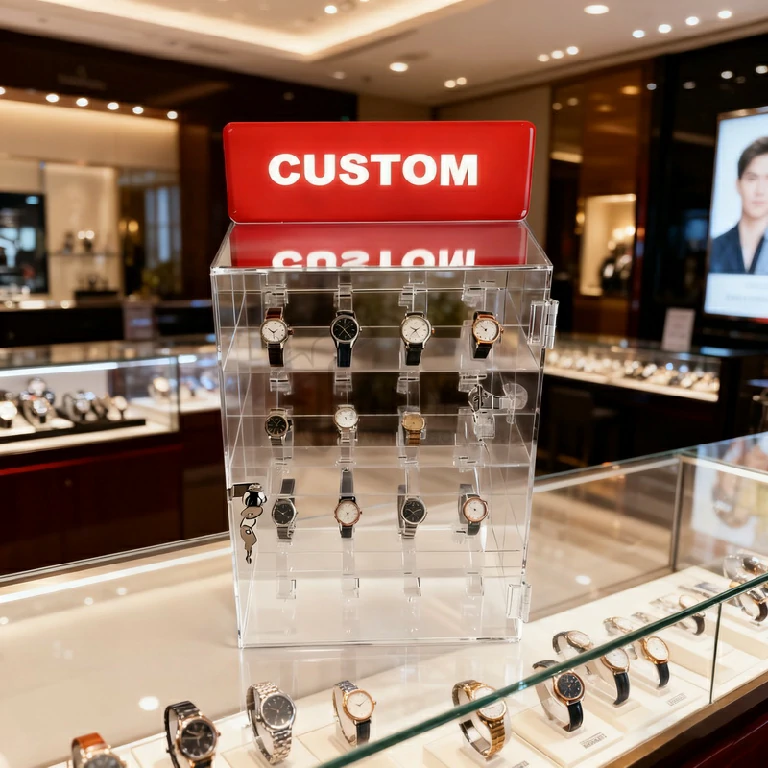
A well-designed countertop smart watch display holder brings these requirements together in one compact retail fixture. It should present the product at a comfortable viewing angle without hiding important details, provide enough stability for frequent customer interaction and leave sufficient space for branding or product information.
For a single boutique, the right solution might be a simple acrylic holder with a printed logo. A multi-store launch may require a coordinated display system with interchangeable graphics, integrated lighting, charging access and anti-theft components. Understanding the intended use before confirming the structure is therefore one of the most important parts of the purchasing process.
Start With the Retail Environment
The first question is not what the holder should look like, but where and how it will be used. A display placed inside a supervised watch counter has different security and structural requirements from one positioned on an open electronics table. A temporary launch display also has different priorities from a permanent fixture intended for installation across dozens of retail locations.
Counter dimensions, customer traffic, viewing direction and the number of watch models all affect the design. A small countertop holder may work well when one flagship product needs individual attention. A longer display base with several watch positions is more suitable when customers need to compare sizes, colors or product generations.
The available counter area must also be considered. A display that is visually impressive in a rendering may become inconvenient if it blocks staff movement, occupies too much selling space or interferes with nearby products. Providing the manufacturer with the counter dimensions and store photographs makes it easier to design an appropriate footprint.
Choose a Structure That Presents the Watch Naturally
Smartwatches should normally be displayed at an angle that allows customers to see the screen without leaning over the counter. However, the correct angle depends on the counter height, expected viewing direction and whether the customer is allowed to handle the device.
The holder must support the watch without placing unnecessary pressure on the strap. Different strap materials also behave differently. Silicone straps, metal bands and leather straps may require different holder shapes or support dimensions. If several watch models will share one display, the manufacturer should determine whether a universal holder or replaceable inserts would be more practical.
A multi-position display needs sufficient distance between each watch. If the products are placed too closely together, customers may have difficulty comparing them, and charging or security cables can quickly make the counter look disorganized. The structure should keep each product visually separate while maintaining a consistent brand presentation.

Acrylic, Metal or Mixed-Material Construction?
Acrylic is widely used for countertop smart watch displays because it can be cut, printed, polished, bent and produced in clear or customized colors. Clear acrylic creates a lightweight visual appearance, while black, white or brand-colored acrylic can give the display a stronger promotional identity.
Metal components may be added where the structure requires extra reinforcement, a fixed connection or a particular surface finish. MDF, ABS and printed panels can also be combined with acrylic when the project calls for a more substantial base or a specific merchandising style.
The best material combination depends on the size of the display, number of devices, lighting configuration and expected handling. Material thickness should therefore be selected according to the complete structure rather than treated as an isolated purchasing specification.
| Material option | Main visual effect | Suitable application |
|---|---|---|
| Clear acrylic | Minimal obstruction and high product visibility | Individual watch holders and clean technology counters |
| Colored acrylic | Stronger brand identity | Campaigns, launches and branded retail counters |
| Acrylic with metal | More structural reinforcement | Interactive displays and permanent store installations |
| Acrylic with MDF | Solid base and flexible surface finishing | Coordinated retail display programs |
| Acrylic with printed panels | Strong promotional communication | Seasonal campaigns and replaceable product launches |
Plan Charging and Cable Management Early
One of the main differences between a traditional watch holder and a retail smartwatch display is the need for continuous charging. The charging puck, cable direction, connector position and power supply must be considered during structural design.
If these details are added only after the display has been manufactured, exposed cables may interfere with the product position or make the counter appear untidy. The base can instead be designed with charging openings, cable-routing channels and internal space for excess cable length.
Retailers should provide the charger dimensions and cable information during the design stage. When different watch brands are displayed together, each charging system should be reviewed separately because the puck dimensions and cable exits may not be identical.
Match the Security Level to the Store
Security requirements depend on product value, store layout and how freely customers are expected to interact with the smartwatch. A supervised counter may only require a discreet tether, while a high-traffic electronics store may need a more integrated anti-theft system.
Security should not prevent customers from examining the watch. The aim is to allow a natural demonstration while keeping the product attached to the display area. Cable routing, alarm components and attachment points must be coordinated with the charging system so the counter does not become crowded.
Current retail-security solutions commonly distinguish between countertop, end-cap, slanted-board and wall installations, with different security levels based on traffic and exposure.Smart Watch Retail Security Guide For custom production, the buyer should provide the intended security device or technical specification before the prototype is developed.

Use Lighting Without Distracting From the Screen
LED lighting can make a smartwatch display more noticeable, particularly in shopping malls, electronics stores and launch areas. Lighting may be integrated into the base, logo panel or sloped display surface.
The lighting should support the product presentation rather than compete with the illuminated smartwatch screen. Brightness, light color and diffusion need to be evaluated together with the acrylic color and printed graphics. A soft edge-lit logo may suit a premium brand, while a larger illuminated advertising panel may work better for a promotional campaign.
The website's existing smartwatch display uses an illuminated sloped base and a replaceable magnetic advertising area, showing how lighting and interchangeable graphics can work together without rebuilding the entire fixture for each campaign.TINYA Watch Display Rack

Turn the Holder Into a Brand Communication Space
A countertop display is often one of the closest brand touchpoints in the store. Even a small holder can include a logo, campaign color, product name, key feature or replaceable promotional message.
Depending on the design, branding can be produced through UV printing, silk-screen printing, pad printing, laser processing, hot stamping, acrylic lettering or replaceable graphic panels. The correct method depends on the artwork, quantity, desired finish and whether the campaign information will need to be updated later.
Retailers planning frequent product launches should consider a permanent display structure with replaceable graphics. This allows new watch models, prices or promotional messages to be introduced without replacing the complete display.
What Buyers Should Confirm Before Sampling
Before a prototype is produced, the buyer and manufacturer should confirm the watch dimensions, strap type, charging system, display quantity, counter dimensions, viewing angle, security requirement, logo artwork and destination market.
The prototype should then be evaluated with the real watch and charger whenever possible. A visual sample that contains no device may look correct but still reveal problems when the charging puck, strap and security cable are installed.
The sample review should check whether the watch remains stable, whether the screen is clearly visible, whether the strap sits naturally and whether customers can lift or try the device without pulling the entire fixture. Logo position, lighting, cable access and installation should also be confirmed before bulk production.

Quality Control for Multi-Store Projects
Batch consistency is especially important when the same smartwatch display will be installed across multiple stores. Differences in holder angle, logo position, acrylic color or LED brightness become more visible when several displays appear together.
Quality inspection should cover dimensions, edge finish, surface condition, printing position, bonding or assembly, structural stability, electrical function and compatibility with the approved device. Protective film and appropriate cushioning should be used to reduce scratching and movement during transportation.
For displays containing lighting or electronic components, the destination voltage, plug type and installation requirements should be confirmed before production. Packaging should also be designed around the finished structure. A knock-down design may reduce shipping volume, but it must remain simple enough for store employees to assemble consistently.
Custom or Standard: Which Is Better?
A standard watch holder may be suitable when the retailer needs a small quantity for basic product presentation and does not require coordinated branding. A custom display becomes more valuable when the project includes several stores, a new-product launch, specific charging requirements or a defined brand identity.
| Requirement | Standard holder | Custom holder |
|---|---|---|
| Basic watch support | Suitable | Suitable |
| Brand-specific color and logo | Limited | Fully adaptable |
| Exact charging-puck integration | Usually limited | Designed around the device |
| Anti-theft system integration | May require modification | Planned during development |
| Multi-watch comparison layout | Limited options | Customized spacing and quantity |
| Replaceable campaign graphics | Uncommon | Can be incorporated |
| Multi-store visual consistency | Difficult to control | Developed from an approved sample |
The decision should be based on the full retail program rather than unit price alone. A display that fits the device, counter and installation process can be easier to reproduce and deploy consistently.
Developing a Custom Countertop Smart Watch Display Holder
TINYA develops custom acrylic and mixed-material retail displays for brands, retailers and commercial projects. A buyer can begin with a drawing, product dimensions, store photograph or reference image. The structure can then be developed around the number of watches, charging system, security method, branding and installation environment.
Before requesting a quotation, prepare the required quantity, watch dimensions, counter dimensions, logo artwork, lighting preference, security requirements and destination market. These details allow the manufacturer to evaluate the structure and provide a quotation based on the actual project rather than a generic holder.
Send us your smartwatch dimensions, charger details, required quantity and reference image to request a custom display solution.

FAQ
What is a countertop smart watch display holder?
It is a compact retail fixture designed to present one or more smartwatches on a counter. Depending on the project, it may include charging access, cable management, anti-theft components, LED lighting and custom branding.
Can one holder fit different smartwatch models?
A universal holder may be possible when the watches have similar dimensions and strap structures. For substantially different products, replaceable inserts or separate holders can provide better stability and presentation.
Can the charging puck be built into the display?
Yes. The charger dimensions, cable exit and power requirements should be provided before structural design so the puck and cable-routing system can be incorporated properly.
Can the display include an anti-theft system?
An anti-theft tether, alarm component or another security solution may be integrated according to the store environment. The intended security hardware should be confirmed before sampling.
Can the logo or advertising graphic be changed later?
A display can be designed with magnetic, sliding or otherwise replaceable graphic panels. This is useful for retailers that update product launches or seasonal campaigns regularly.
What information is required for a quotation?
The manufacturer normally needs the required quantity, watch dimensions, number of display positions, counter size, material preference, Logo artwork, charging method, security requirements, lighting preference and delivery market.
Should buyers order a sample before bulk production?
A sample is strongly recommended for a customized retail program. It allows the buyer to test the actual watch, charger, security system, viewing angle, lighting and assembly before approving batch production.