

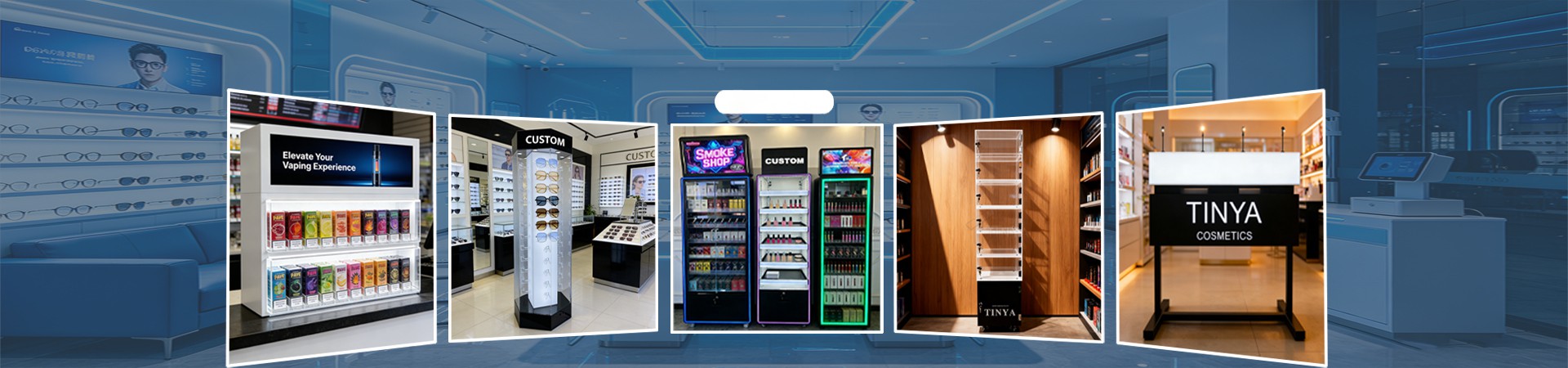
In modern retail display design, there is a clear shift happening in how materials are being used. The focus is no longer on selecting a single "best-looking" material, but on defining what role each material should play within a system.
Acrylic, metal, and MDF are increasingly being combined in a structured way. Each material is assigned a specific function, allowing display systems to become more stable, more visually refined, and more efficient to manufacture.
What is changing is not only the material choice itself, but the way designers think about structure, production, and long-term usability.


A Simple Principle: Each Material Has a Defined Role
In practical display engineering, multi-material systems usually follow a straightforward rule:
- Metal = structural frame and load-bearing system
- Acrylic = visual display and optical layer
- MDF = base support and environmental warmth
This division is not theoretical-it is how most functional retail display systems are already being built today.
Once these roles are clearly defined, design decisions become more practical. Instead of asking "what material should this be?", the question becomes "what function does this part need to achieve?"
This shift alone significantly reduces unnecessary design complexity.
👉 If you are planning a custom retail display project, understanding this functional material allocation can significantly improve both cost efficiency and visual performance.
Metal: The Invisible Structural Backbone
Metal, usually aluminum or stainless steel, forms the internal skeleton of most modern display systems.
Its core functions include:
- Supporting total structural load
- Connecting modular components
- Maintaining long-term stability
- Enabling scalable and reusable systems
In real production, metal structures are rarely visible. They are designed to be hidden inside the product, allowing the external surfaces to remain clean and minimal.
Another important advantage is manufacturability. Metal frames can be standardized, which means the same internal structure can be reused across different display variations.
From a production point of view, this reduces cost over time and improves consistency across large retail rollouts.
As display structures become larger and more complex, metal is no longer optional-it is the foundation that ensures everything else can function safely.

Acrylic: More Than Just Transparency
Acrylic is often associated with its clear and modern appearance. While transparency is important, its role in display systems goes far beyond visual clarity.
In practice, acrylic serves two distinct functions depending on its type and application.
1. Transparent acrylic: Visual presentation layer
This version is used to clearly present products while minimizing visual interference. The goal is to keep attention focused on the product itself rather than the structure holding it.
2. Opal (milky white) acrylic: Optical diffusion layer
In lighting-integrated display systems, milky white acrylic plays a completely different role.
Instead of simply allowing light to pass through, it is used to diffuse and balance illumination across a surface.
Its practical functions include:
- Converting point light sources into uniform surface lighting
- Eliminating visible LED dots or hotspots
- Reducing uneven brightness distribution
- Creating a soft and consistent ambient glow
This is especially important in premium retail environments where lighting quality directly affects product perception.
In applications such as fragrance displays, cosmetics counters, LED branding structures, or illuminated bases, lighting consistency is often as important as structural design.
From an engineering perspective, opal acrylic acts as an optical control layer, not just a decorative surface.
A simple way to understand this is:
Transparent acrylic makes products visible.
Milky acrylic makes lighting visually comfortable.

MDF: Environmental and Emotional Layer
MDF plays a different role compared to metal and acrylic. It is not primarily structural or optical-it is emotional and environmental.
Its main roles include:
- Providing a stable visual foundation
- Softening the contrast between metal and acrylic
- Enhancing brand atmosphere
- Supporting base-level structure elements
In retail environments, especially in fragrance, cosmetics, and lifestyle categories, MDF is often used to create a sense of warmth and accessibility.
It helps balance the more technical or industrial feeling of metal and acrylic, making the overall system feel more natural and human-centered.

How the System Works in Real Design and Production
In actual projects, multi-material display systems are not assembled randomly. They follow a layered engineering logic that is defined early in the design process.
A typical structure can be understood as:
- Metal forms the internal structural frame (hidden)
- MDF forms the base and visual grounding layer
- Acrylic forms the upper visual and lighting layer
This structure is not only a design choice, but also a manufacturing strategy.
From a production perspective, this approach provides:
1. Easier fabrication
Each material can be processed separately using its own optimized production method.
2. Faster assembly
Modules can be pre-produced and assembled quickly at the final stage.
3. Lower long-term cost
Standardized metal frames reduce redesign and tooling costs across different projects.
4. Better quality control
Each material undergoes independent quality checks before integration.
👉 We support OEM/ODM customization for multi-material display systems. If you are developing a retail display project, feel free to contact us for structural design support or quotation.
A Practical Design Rule Used in Real Projects
In day-to-day development work, this system can be simplified into a decision-making framework:
If a part needs strength → use metal
If a part needs visual clarity → use transparent acrylic
If a part needs lighting comfort → use milky (opal) acrylic
If a part needs atmosphere → use MDF
This rule is widely used in real engineering communication because it reduces ambiguity between design teams, engineers, and manufacturers.
It also helps prevent one of the most common issues in display development: over-designing a single material instead of distributing functions properly.
Cost, Manufacturing, and Practical Constraints
Beyond design considerations, material selection is also influenced by real production constraints.
In commercial display projects, three factors often determine the final structure:
1. Material cost balance
Metal provides long-term durability but increases initial cost. Acrylic is relatively flexible but requires careful handling. MDF introduces variability depending on finishing requirements.
2. Production scalability
Multi-material systems allow manufacturers to standardize metal frames while customizing only visible parts like acrylic panels or MDFen surfaces. This improves scalability for large retail rollouts.
3. Logistics and installation efficiency
Modular metal-based structures reduce shipping volume and simplify on-site installation. This is especially important for global retail networks where installation time is limited.
In many cases, design decisions are not purely aesthetic-they are directly influenced by logistics, assembly time, and long-term maintenance requirements.
Why This Approach Is Becoming Industry Standard
The increasing adoption of multi-material systems is driven by real operational needs in retail:
- Faster product cycles requiring flexible display updates
- Growing demand for modular and reusable structures
- Higher expectations for lighting quality and visual experience
- More complex retail environments across global markets
Single-material solutions often struggle to balance these requirements simultaneously. Multi-material systems solve this by distributing functions across different materials rather than forcing compromise.
This is why the industry is gradually moving toward a more engineering-driven approach to display design.
Common Application Areas
This design approach is now widely used in:
- Fragrance and cosmetics displays
- Consumer electronics presentation systems
- Retail countertop display units
- Exhibition and trade show installations
- Premium POP and branded display systems
Across these categories, both structural reliability and lighting quality are becoming essential requirements rather than optional enhancements.
Multi-material display design is not simply a material combination strategy. It is a functional design method where each material is assigned a clear and practical role within a larger system.
When properly structured:
- Metal provides stability and strength
- Acrylic handles visual presentation and lighting diffusion
- MDF provides emotional tone and environmental balance
This approach results in display systems that are not only more efficient to build, but also more refined in both visual and lighting performance.
As retail environments continue to evolve, this role-based material system is increasingly becoming a standard approach in professional display engineering rather than just a design trend.