

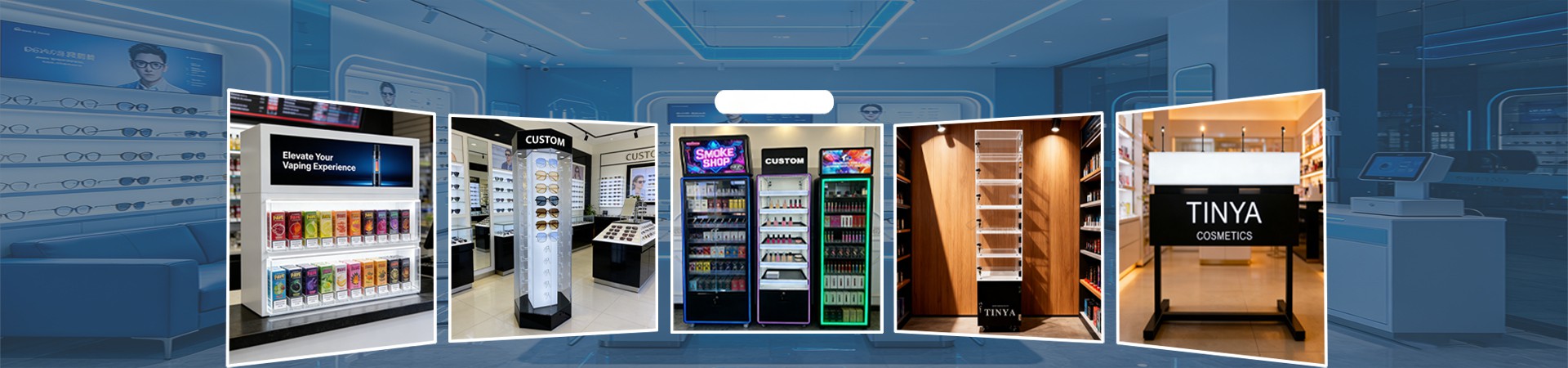

A skincare display stand and a makeup display stand may look similar in a rendering, but they solve different merchandising problems. Skincare ranges usually combine bottles, jars, tubes, droppers and boxed products with different heights and footprints. Shoppers often need to understand a routine, compare benefits and identify the order in which products should be used. Makeup ranges tend to contain more small SKUs, shade variations, replaceable testers and product-specific holders for lipstick, mascara, foundation, palettes or nail color.
For beauty brands, retailers and distributors, the practical question is not which display looks more luxurious. It is which structure makes the assortment easier to understand, safer to test, simpler to replenish and more consistent to reproduce across multiple stores. This guide compares the two display types from a buyer's perspective and explains when a custom acrylic structure, a mixed-material fixture or a hybrid solution makes the most sense.

Why Skincare and Makeup Displays Should Not Use the Same Layout
The difference begins with how shoppers make decisions. A skincare customer may look for a cleanser, serum, moisturizer and sunscreen as parts of one routine. A well-planned skincare display stand can guide that sequence through stepped shelves, product zones, benefit messages and clearly separated hero products. The display often needs enough vertical clearance for pump bottles and cartons while keeping shorter jars visible at the front.
Makeup shopping is usually more shade- and category-driven. A shopper may compare several lipstick colors, test a foundation tone or look for a matching eye product. This requires higher SKU density, smaller compartments, clear shade organization and easier tester replacement. If a skincare layout is reused without modification, makeup items may appear sparse or disorganized. If a dense makeup tray is reused for skincare, larger bottles may hide one another and leave no room for educational messaging.
Skincare Display Stand vs Makeup Display Stand
| Comparison point | Skincare display stand | Makeup display stand | Purchasing implication |
|---|---|---|---|
| Typical products | Serums, creams, cleansers, toners, sunscreen, masks and boxed sets | Lipstick, foundation, mascara, palettes, eyeliner, nail color and testers | Product samples or verified dimensions are needed before the holder layout is finalized |
| Merchandising logic | Routine, concern, benefit or product step | Category, shade, finish or tester group | The graphics and product sequence should follow how customers compare the range |
| SKU density | Usually moderate, with more size variation | Often high, with many small products and shades | Makeup displays usually need more slots, dividers or replaceable inserts |
| Product stability | Bottle and jar footprints may vary significantly | Many items are slim, compact or rectangular | Skincare needs stable pockets and risers; makeup needs precise small-item organization |
| Tester requirements | Pumps, droppers, cream jars and sample cards | Shade testers, applicators, palettes and disposable tools | Tester zones should be removable and easy to clean or replace |
| Information area | Ingredients, benefits, routine steps and campaign messaging | Shade names, color families, finishes and product categories | Skincare commonly needs more educational space; makeup needs faster visual navigation |
| Lighting priority | Clear label visibility and premium brand presentation | Consistent color appearance and accurate shade comparison | LED position, diffusion and reflection should be approved using real products |
| Replenishment | Fewer facings but larger and heavier packs | More facings and frequent shade-level restocking | Rear access, removable trays and SKU labels should reflect store operations |
| Common format | Countertop riser, branded tray, wall bay or floor unit | Tester bar, countertop tray, gondola insert or wall fixture | Choose the format according to rollout size, store space and access frequency |
Product Fit Is the First Design Decision
The most common sourcing mistake is approving the appearance before confirming the product fit. A supplier cannot design reliable openings and dividers from a front-view photo alone. The brief should include each product's width, depth, height, weight and cap or pump position. Boxed and unboxed versions should be treated separately because the footprint may change significantly.
For skincare, the design must prevent tall bottles from tipping while avoiding excessive walls that hide the label. Short jars often benefit from raised positions or front rows. Droppers and pumps need enough overhead clearance, and round bottles may require shaped supports if the display will be moved frequently. Gift sets and cartons may need a wider back section rather than individual cutouts.
For makeup, the insert logic is usually more detailed. Lipstick openings, mascara channels, palette ledges and foundation pockets all require different dimensions. The buyer should also decide whether the fixture will hold saleable stock, testers or both. A beautiful tray becomes difficult to operate if store staff must remove several products to replace one tester.
Acrylic, Metal and MDF: Which Material Fits Each Display?
Clear and colored acrylic are useful for countertop beauty displays because they provide precise product openings, polished visual surfaces and flexible branding options. Acrylic can be laser cut, CNC machined, bent, bonded and printed, allowing the manufacturer to develop risers, pockets, trays, back panels and replaceable inserts around the actual packaging.
However, an entire display does not always need to be acrylic. A larger floor-standing skincare display may benefit from a metal internal frame for structural support or an MDF base for weight and stability. Makeup fixtures with many testers may use an acrylic top assembly combined with a more rigid cabinet or storage section. Mixed-material construction can improve strength, visual depth and serviceability when each material has a clear function.
Material selection should therefore follow the structure rather than a generic preference. The buyer should ask the factory to explain why a proposed thickness, base or reinforcement is suitable for the panel span, product weight, door or drawer hardware and shipping method.

Countertop or Floor-Standing: The Better Retail Format
A countertop skincare display stand works well for launches, hero products, travel sizes, treatment routines and focused collections. It is easier to place near consultation areas, checkout zones or existing shelving. The limited footprint forces the range to be edited, so the display should prioritize the most important products and messages instead of trying to hold every SKU.
A floor-standing skincare fixture offers more room for complete routines, gift boxes and back stock. It can carry a larger brand header, illuminated graphics or campaign panels, but it also introduces more engineering and logistics questions. The base must remain stable in a high-traffic environment, shelves must support the intended load, and the packaging must protect larger components during international shipping.
Makeup countertop units are particularly effective for a defined product family such as lipstick or foundation. Larger makeup programs may require wall bays, gondola inserts or modular floor units because the number of shades and testers quickly exceeds the capacity of a small tray. A modular system can preserve a consistent exterior style while allowing different inserts for each product category.

Lighting and Branding Need Different Priorities
Skincare displays often use lighting to create a clean, premium presentation and draw attention to product benefits or hero packaging. Makeup lighting has an additional challenge: colors must remain easy to compare. Reflections, strong hotspots or colored LEDs may make the fixture noticeable while making shade selection harder.
The best approach is to test lighting with actual packaging and tester samples. The design review should confirm LED position, diffusion, power routing, switch access, heat management and the voltage required in the destination market. External store lighting should also be considered because a display that looks balanced in a dark rendering may create glare under retail ceiling lights.
Branding options can include UV printing, silk-screen printing, laser engraving, color acrylic, metallic accents, removable graphic panels and illuminated logos. Skincare graphics often need enough space for routine steps or benefit messages. Makeup graphics should support category and shade navigation without competing with the color range. In both cases, removable campaign panels can make the structure easier to update.

When a Hybrid Beauty Display Is the Better Choice
Many beauty brands sell both skincare and makeup, so the final answer is not always one display or the other. A hybrid display can work when the range is divided into clearly defined zones. For example, the upper section may present educational skincare messaging and hero products, while the lower or side section uses denser replaceable trays for makeup testers.
The danger is creating one large fixture without a clear shopping path. Combining categories should make comparison easier, not simply increase capacity. A hybrid design should use visual separation, consistent SKU labels, product-specific inserts and a logical replenishment route. If skincare and makeup collections change on different schedules, modular components allow one section to be updated without replacing the full fixture.
What Wholesale Buyers Should Confirm Before Ordering
Before requesting a quotation, prepare the product list, dimension sheet, packaging photos, display quantity, destination market and preferred retail format. Explain whether the project is for a single launch, a chain-store rollout, a distributor program or a display product intended for resale. Include the number of saleable units and testers each display must hold.
The design brief should also cover logo artwork, brand colors, graphic language, lighting, locks or drawers, assembly preference and packaging requirements. If the display must ship flat, the connection method and store assembly process need to be evaluated at the drawing and sample stages. If it ships assembled, the carton size and protective packaging become more important.
Shenzhen Tinya Acrylic Display Co., Ltd. was established in 2005 and provides OEM/ODM display development from Shenzhen, China. Our team can support 2D/3D design, acrylic structures and project-specific combinations of acrylic, metal, MDF and ABS. Available processes include UV printing, silk-screen printing, pad printing, laser processing, hot stamping and heat transfer. Lighting, locks, knock-down structures and anti-theft features can also be evaluated according to the project.
For a custom skincare display stand, the most useful first step is to send real product dimensions or samples rather than selecting a generic catalog structure. This allows the factory to evaluate fit, stability, visibility, manufacturing method and packaging as one system.
FAQ
What is the main difference between a skincare display stand and a makeup display stand?
A skincare display usually organizes products by routine, concern or benefit and must accommodate bottles, jars, tubes and boxes of different sizes. A makeup display normally carries more small SKUs and shades, so it needs denser product openings, clearer category labels and more detailed tester organization.
Is acrylic suitable for skincare product displays?
Yes. Acrylic is widely used for clear and colored trays, risers, product pockets, logo panels and countertop structures. The correct thickness and construction depend on the product weight, panel span, hardware and shipping method. Larger fixtures may combine acrylic with metal or MDF for additional support.
Can one display hold both skincare and makeup?
Yes, provided that each category has a dedicated zone and product-specific insert. A modular hybrid display is usually more practical than forcing bottles, jars, lipstick and palettes into one universal tray.
Should the display include tester holders?
If customers will test products, tester locations should be designed from the beginning. Confirm the tester dimensions, applicator storage, cleaning method, replacement frequency and separation from saleable inventory before approving the drawing.
Can LED lighting be added to a skincare display stand?
LED lighting can be integrated into logo panels, shelves, bases or product zones. The final design should confirm reflection, diffusion, wiring access, power standard and packaging. Testing the lighting with real products is recommended before mass production.
What information does a manufacturer need for a quotation?
Provide product dimensions and weights, reference images, quantity, required capacity, display location, logo artwork, color requirements, lighting or hardware needs, destination market and preferred packaging. A physical sample can improve fit verification for complex bottles and testers.
What is the MOQ for a custom beauty display?
MOQ depends on the size, materials, structure, tooling, electronics and order value. Countertop units and large floor fixtures may have different practical starting quantities. Send the target quantity and expected repeat volume so the factory can recommend an appropriate structure and quote.
How should a buyer compare display samples?
Check product fit, stability, edge finish, color and print consistency, tester access, removable-part movement, lighting performance, assembly, cleaning access and packaging protection. The approved drawing and sample should become the quality reference for mass production.
Develop the Right Display for the Product Range
A skincare display stand should make routines and product benefits easier to understand, while a makeup display stand should make categories, shades and testers easier to compare. The right solution may be a focused countertop unit, a larger floor fixture or a modular hybrid system. In every case, product fit, store operation and repeatable manufacturing should guide the design.
Send TINYA your product dimensions, reference photos, required quantity, retail environment and branding files. Our team can evaluate the structure and prepare a custom display proposal and factory quotation for your beauty retail project.